


Portion Distortion - How much is on your plate?
I love to eat out. Like many Americans, I'm busy, and I enjoy the convenience of grabbing a quick bite. And we're doing it more than ever before.
The numbers tell a striking story: Americans now spend more on food away from home than on groceries. 55.7% of our food budget goes to restaurants, takeout, and fast food, marking an all-time high. The average American spends about $191 per month on dining out alone, not counting takeout and delivery.
All told, we now get one-third of our daily calories from eating out, with fast food alone accounting for 16% of our total daily caloric intake. That's nearly triple what it was in the late 1970s when it was just 6%.
This dramatic shift in how and where we eat has coincided with America's growing obesity problem, and lurking behind this trend is a culprit many of us don't even notice.
To outdo their competition, many restaurants have jumped on the "supersize everything" bandwagon. Portions are so huge the terms small, medium and large no longer apply. Now it's more like big, huge and gigantic. We've started to get used to eating up to a pound of food at one sitting.
Over time, all those extra calories have been adding up and moving right to America's waist. The transformation has been dramatic: in the 1970s, eating out was an occasional treat. Americans spent only 34% of their food budget on food away from home. Today that figure stands at 55.7%. During that same period, our daily calorie consumption climbed from about 1,807 calories in 1978 to 2,093 calories in 2018. Research confirms portion sizes began growing in the 1970s, rose sharply in the 1980s, and have continued increasing in parallel with rising body weights.
Care to reverse the trend?
In my article "Trainer in a Box," I suggested that to get weight under control, you should try tracking your calories in a food log. It's a great tool to make yourself aware of just how much you're eating and start making informed decisions to cut back. There was one big problem with that suggestion, and several of you were quick to point it out.
It's difficult to accurately gauge just how much food is in those restaurant servings! When I quizzed a few clients, they were almost always underestimating how much they were eating. It's called "portion distortion." When I dug a little deeper, it turns out when questioned; even the experts get it wrong.
Nutrition consultant Lisa Young showed 200 dietitians five plates of food typically served in restaurants. Many had no idea how many calories were in the foods they were shown. Some underestimated the calories by half!
Studies show that when served larger portions, people consume up to 30% more calories without feeling any more satisfied. Doubling portion size at a meal increases energy intake by an average of 35%. And here's the kicker: hunger makes it worse. People who estimate portion sizes while hungry underestimate calories by nearly three times more than those who aren't hungry. For example, hungry people underestimated the calories in a bagel by 24% compared to just 5% for those who had recently eaten.
If the experts couldn't do it, how can you?
It's easy. (Didn't you just know I'd have a solution?) Use the common items listed below and compare your serving sizes to them. Not sure how many ounces that steak has in it? Compare it to a deck of cards. Don't know how much salad dressing is acceptable? Hold it next to a shot glass or compare it to a ping pong ball. Each of these common items can give you a fairly accurate estimate of how large or small a particular serving is.
Research confirms this approach works. A 2021 systematic review found that portion control tools, including visual aids and reduced-size tableware, effectively help people learn appropriate portion sizes and reduce calorie intake. Studies show that using visual portion tools can reduce calorie intake by up to 22% and contribute to meaningful weight loss when used consistently.
If the portions are too large, you can ask for a doggie bag and cut it down to size before you start eating. You won't leave feeling stuffed, and you'll have another meal you can easily reheat later.
To make sure you're watching things at home, keep these items in a bowl on your kitchen counter and use them as a quick reference to avoid portion distortion when you're cooking for yourself.
 |
Matchbook
1 ounce of meat (Beef, Poultry of Pork) |
 |
Deck of Cards
3 ounces of meat (Beef, Poultry or Pork) |
 |
Checkbook
3 ounces of white fish (Flounder, Sole or Grouper) |
 |
Ping Pong Ball or Shotglass
2 Tablespoons (Salad Dressing) |
 |
Postage Stamp
1 teaspoon (Butter or Margarine) |
 |
Baseball
1 cup (Cereal, Popcorn, Pasta or Potatoes) |
 |
2 Dominos
1 ounce (Cheese) |
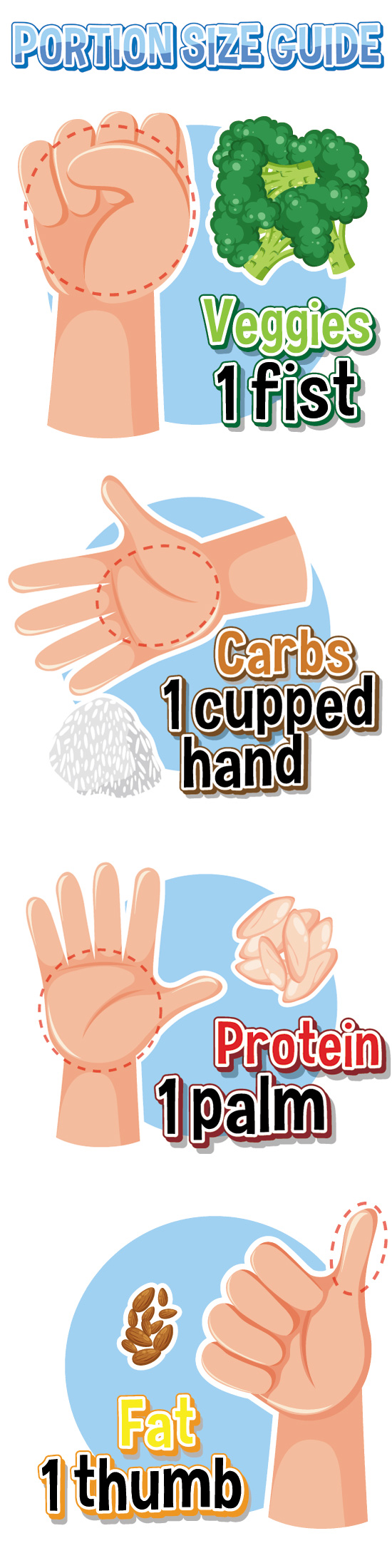
After awhile, spotting oversized food and cutting it down to size will become second nature. It's a simple step you can take for your health. Be aware and show your body you care.
How much do you remember? Click Here for our Portion Distortion quiz.
Reference Links:
The Contribution of Expanding Portion Sizes to the US Obesity Epidemic
Lisa R. Young and Marion Nestle
American Journal of Public Health, Published Online: October 10, 2011
Click Here for the Study: https://ajph.aphapublications.org/doi/10.2105/AJPH.92.2.246
An exploration of customers’ perceptions, preferences, experiences, and feasibility of offering standardized portions in restaurants
Titilola Labisi, Melissa Preciado, Allison Voorhees, Amorette Castillo, Kelly Lopez, Christina Economos, Mary Story and Deborah A. Cohen
International Journal of Gastronomy and Food Science, Published December 2023, 100829
Click Here for the Study: https://doi.org/10.1016/j.ijgfs.2023.100829
Sizing up the Effect of Portion Size on Consumption: A Meta-Analytic Review
Natalina Zlatevska, Chris Dubelaar, and Stephen S. Holden
Journal of Marketing - American Marketing Association, Published online May 1, 2014
Click Here for the Study: https://doi.org/10.1509/jm.12.0303
Portion, package or tableware size for changing selection and consumption of food, alcohol and tobacco
Gareth J Hollands 1, Ian Shemilt, Theresa M Marteau, Susan A Jebb, Hannah B Lewis, Yinghui Wei, Julian P T Higgins, David Ogilvie
Cochrane Database of Systematic reviews , Published 2015 Sep 14;2015(9):CD011045.
Click Here for the Study: https://doi.org/10.1002/14651858.cd011045.pub2
Wanting More, Seeing Less: Hunger Reduces Calorie Evaluations
Guglielmo Bonaccorsi, Chiara Lorini, Virginia Vettori
International Journal for Environmental Research in Public Health, Published 2021 Nov 23;18(23):12270.
Click Here for the Study: https://doi.org/10.3390/ijerph182312270
Impact of Portion Control Tools on Portion Size Awareness, Choice and Intake: Systematic Review and Meta-Analysis
M Angeles Vargas-Alvarez, Santiago Navas-Carretero, Luigi Palla, J Alfredo Martínez, Eva Almiron-Roig
Nutrients, Published 2021 Jun 9;13(6):1978
Click Here for the Study: https://doi.org/10.3390/nu13061978
The Diner Dispatch: 2024 American Dining Habits
US Foods, Published 2024
Click Here for the Study: https://www.usfoods.com/our-services/business-trends/american-dining-out-habits-2024.html
Call for a FREE Consultation (305) 296-3434
CAUTION: Check with your doctor before
beginning any diet or exercise program.
5/12/2006
Updated 2/22/2013
Updated 12/24/2025


