


Caffeine and Your Workouts
(Part 2 of 2)
Last week I posed two questions about caffeine. The first was, "Is caffeine something that can help me get in better shape?" The answer was no. There are no current studies that show caffeine is beneficial for muscle building or fat reduction. But for you caffeine lovers, the news isn't all bad. There is something it appears to do very well.
Caffeine may help relieve pain from DOMS (Delayed Onset Muscle Soreness). At the Department of Kinesiology at the University of Georgia, they gave subjects 5 mg. of caffeine per kg of body weight to see if it helped reduce muscle pain from DOMS. The results were surprising. They found that "...caffeine could produce a large reduction in pain resulting from eccentric exercise-induced, delayed-onset muscle injury."
Finally! Something that caffeine does well for people who exercise.
Of course, there was a downside. It was only tested on people who were "Low caffeine-consuming." Habitually high caffeine users develop a tolerance that reduces caffeine's effects over time. So if you take caffeine daily, it might not be effective in reducing DOMS for you.
The second question I asked last week is a little tougher to answer. I wanted to know if caffeine is safe.
Caffeine is a stimulant that the U.S. Food and Drug Administration classifies as GRAS (Generally Recognized as Safe).
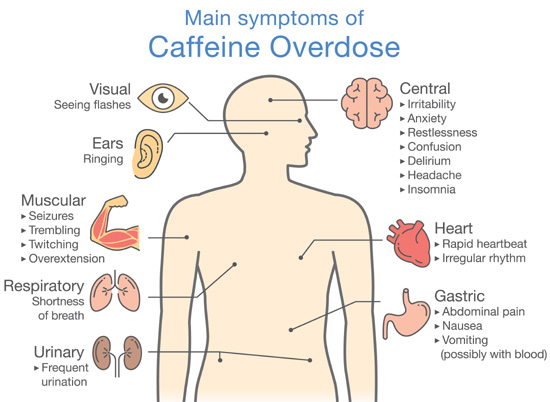
Unfortunately, caffeine is also an addictive drug, and like all drugs, you build up a tolerance to it. To continue getting the wake-up jolt you experience with that first cup of coffee; you have to gradually increase the dosage. In essence, you must take in more caffeine to overcome the tiredness brought on by caffeine withdrawl. As caffeine levels rise, you may start to experience other wonderful little problems like diarrhea, dizziness, cramps, fatigue, headaches, heartburn, insomnia, irritability, nausea, nervousness, palpitations or vomiting.
You have to decide if the benefits of alertness and initial reduction in fatigue are worth the side effects.
| Name | Serving | Caffeine |
| SODA | ||
| Coca Cola Classic | 12 oz. can | 34.5 mg |
| Diet Coke | 12 oz. can | 46.5 mg |
| Mountain Dew | 12 oz. can | 45.4 mg |
| Pepsi | 12 oz. can | 37.5 mg |
| Diet Pepsi | 12 oz. can | 36 mg |
| Sunkist Orange | 12 oz. can | 41 mg |
| SPORTS & ENERGY DRINKS | ||
| AMP Energy Drink | 8.4 oz. can | 75 mg |
| Full Throttle | 16 oz. | 144 mg |
| Red Bull | 8.5 oz. can | 80 mg |
| (The caffeine levels of Red Bull are so high France and Denmark have banned it.) | ||
| SoBe Adrenaline Rush | 8.3 oz. can | 79 mg |
| COFFEE & TEA | ||
| Coffee | Drip 8 oz. cup | 104-192 mg |
| Coffee, Dunkin' Donuts | Drip 8 oz. | 73.5 mg |
| Coffee, Folgers Instant | 8 oz. cup | 78.6 mg |
| Coffee, Starbucks | Drip 8 oz. | 225 mg |
| Espresso, Starbucks | 1 oz. shot | 35 mg |
| Tea, Black | 8 oz. cup | 40–-100 mg |
| Tea, Green | 8 oz. cup | 24-40 mg |
| FOOD | ||
| Hershey's Chocolate Bar | 1.55 oz. | 9 mg |
| Hershey's Special Dark Chocolate Bar | 1.45 oz. | 18 mg |
Here's where the real problem lies. When you try and figure out how much caffeine you're taking in every day, you run into a wall of silence.
For some reason, most American companies chose NOT to put the total amount of caffeine found in their products. Many don't even list it on the ingredient label. Here's how they get away with it.
Energy drinks might list things like cocoa extract, gotu kola, guarana, white willow bark and yerba maté, all of which have naturally occurring caffeine. While the ingredients would be listed, the caffeine wouldn't because there are no requirements in the United States to list just how much caffeine a product has. There's actually no requirement to list that a product has caffeine in it at all, except as an ingredient if caffeine has been added separately as a pure substance.
So how much caffeine should you take in? The United States government is mute on the subject, so I am listing the recommendations from the Canadian government. Canada not only has clear recommendations but updated them in 2003. Here they are:

For children age 12 and under, Health Canada recommends a maximum daily caffeine intake of no more than 2.5 milligrams per kilogram of body weight. Based on average body weights of children, this means a daily caffeine intake of no more than:
45 mg for children aged 4 - 6;
62.5 mg for children aged 7 - 9; and
85 mg for children aged 10 - 12.
Those recommended maximums are equivalent to about one to two 12-oz (355 ml) cans of cola a day.
For women of childbearing age, the new recommendation is a maximum daily caffeine intake of no more than 300 mg, or a little over two 8-oz (237 ml) cups of coffee.
For the rest of the general population of healthy adults, Health Canada advises a daily intake of no more than 400-450 mg.
Maybe it's time you took a look at your caffeine intake. How much are you taking in each day?
UPDATE: 9/16/2015
Coffee Roasts and Caffeine
Looking to cut down on caffeine? If you measure your coffee out with a scoop, choose the darker roast. Here's why.
When coffee is roasted, the lighter beans don't lose as much mass as the darker roasts. After all, roasting burns away some of the bean. Grind up the beans and the lower mass, darker beans and the higher mass, lighter beans take up about the same amount of space.
Measure your coffee with a scoop? You'll get just a little more of the lighter roast bean in each serving, giving you more caffeine.
Measure your coffee with a scale? You'll get the exact same amount of bean in each serving, giving you the exact same amount of caffeine. So if you measure with a scale, it doesn't matter the roast you choose. The same bean, roasted light or dark, will contain identical amounts of caffeine.
Part 1 2
Reference Link:
Caffeine Attenuates Delayed-Onset Muscle Pain and Force Loss Following Eccentric Exercise
Victor Maridakis, Patrick J. O’Connor, Gary A. Dudley, Kevin K. McCully
The Journal of Pain, Published March 2007
Click Here for the Study: https://www.jpain.org/article/S1526-5900(06)01023-6/fulltext
Call for a FREE Consultation (305) 296-3434
CAUTION: Check with your doctor before
beginning any diet or exercise program.
7/1/2007
Updated 9/16/2015
Updated 2/10/2025


