


Kaizen Your Way to Better Fitness
Four Small Steps Deliver Real Results
The Kaizen approach follows a four-step cycle that repeats continuously. Each cycle builds on what you learned from the previous one. Plan, Do, Chek and Act.
Plan
Identify what you want to improve and create a small, testable change. This is not about planning your entire fitness transformation. You pick one specific thing to try.
Example: "I will add five minutes to my daily walk this week" or "I will do three push-ups before my morning coffee every day."
The plan should be small enough that failure seems unlikely. You are testing an idea, not committing to a permanent change yet.
Do
Execute your plan for a set period, typically one to two weeks. Follow through on the small change you identified without adding other modifications. You want to see if this specific change works before layering on more.
Example: You actually walk those extra five minutes each day for a week, or you do those three push-ups every morning.
Track what happens during this phase. Write down whether you completed the action each day and note any observations about how you felt, what got in the way, or what worked well.
Check
Review your results after the test period. Ask yourself specific questions: Did you complete the action consistently? Did it fit into your schedule? Did you see any improvements? What obstacles came up?
Example: After one week of three daily push-ups, you check your calendar and see you completed it six out of seven days. You notice the push-ups felt easier by day five. You also notice you forgot on the day you slept late and skipped your coffee routine.
This is where you examine data rather than feelings. How many days did you actually do it? What patterns emerged? Be honest about what worked and what did not.
Act
Based on your findings, decide what to do next. If the change worked well, keep it and plan your next small improvement. If it did not work, adjust the plan and try again.
Example: The push-ups worked well when tied to your coffee routine, so you keep that habit and plan to add one more push-up next week. Or, you realize three push-ups before coffee does not work because you are too rushed in the morning, so you adjust the plan to do them after dinner instead.
Then you start the cycle again with your next small improvement.
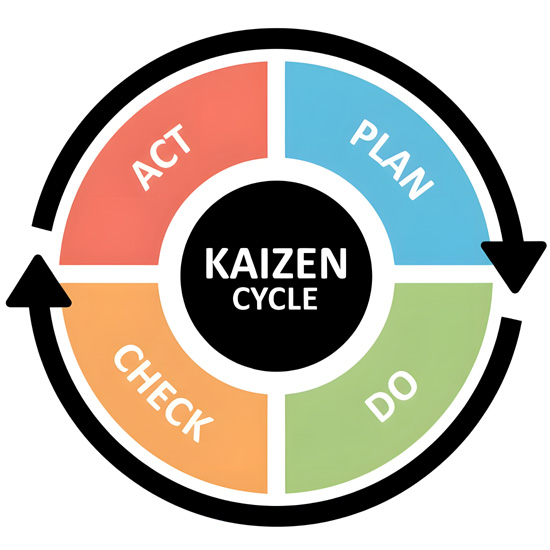
How It Applies to Fitness
The cycle prevents you from sticking with programs that do not work and helps you build on changes that do work. Instead of following a rigid plan for 12 weeks regardless of results, you adapt every week or two based on actual data.
Traditional approach: Follow a predetermined workout plan for three months, realize it does not fit your schedule, quit entirely.
Kaizen cycle: Try a small change for one week, check if it worked, adjust based on results, try the improved version, repeat. Here's what that looks like over three cycles.
Cycle 1:
Plan: Walk 10 minutes after dinner.
Do: Complete it five out of seven days.
Check: Worked on weekdays but failed on weekends when dinner schedule varied.
Act: Keep the weekday walks, plan a different trigger for weekends.
Cycle 2:
Plan: Continue weekday dinner walks, add Saturday morning walk.
Do: Complete both consistently.
Check: Saturday morning worked better than expected, felt energized after.
Act: Keep both walks, plan to add two minutes to walk duration.
Cycle 3:
Plan: Increase all walks to 12 minutes.
Do: Complete consistently for two weeks.
Check: Duration increase felt easy, ready for next challenge.
Act: Keep 12-minute walks, plan to add light jog intervals.
Each cycle builds on the previous one. Small adjustments compound into significant progress over months without requiring you to overhaul your entire routine.
The beauty of this approach is that you never waste weeks following a plan that does not work. You catch problems early and fix them before they become reasons to quit.
Call for a FREE Consultation (305) 296-3434
CAUTION: Check with your doctor before
beginning any diet or exercise program.
11/22/2025


