


Are You A Desk Shrimp?
The internet meme that turned out to be a genuine health warning.
If you end your workday shaped like a question mark, you might be turning into a desk shrimp.
That's the internet's name for what happens when you spend hours hunched over a keyboard or phone. Your head creeps forward, your shoulders round and your upper back curves into a gentle C-shape. You end up looking like a crustacean. The meme is funny, but what it does to your body is not.
Clinicians call it forward head posture combined with thoracic kyphosis. Researchers associate it with increased risk of neck and shoulder pain and other overuse injuries. More than half of office workers report regular pain in those areas.
Here's what happens. Your head weighs about 10 to 12 pounds when it sits directly over your shoulders, where your spine is designed to carry it. As the head moves forward from that position, the load on the cervical spine increases substantially. Lean forward at your desk for hours at a stretch, as most people do, and those structures are working far harder than they should be.
The small postural muscles fatigue first. Once they do, your ligaments and discs absorb the load instead. They can handle it for a while, but they were designed for movement, not hours of static strain.
Desk shrimp posture also reduces chest expansion and breathing efficiency. It compresses the abdomen, which may worsen reflux symptoms in some people. It tightens the hip flexors and shuts down the glutes, which strains the lower back. Over time, it can contribute to increased mechanical stress on the cervical discs and the persistent neck and shoulder pain pattern doctors call tech neck.
There is a mental performance cost, too. Discomfort can interfere with concentration and mental endurance. Those wrist twinges and neck aches are not just annoyances; they're early warning signals. Ignoring them is how a fixable problem becomes a chronic one.
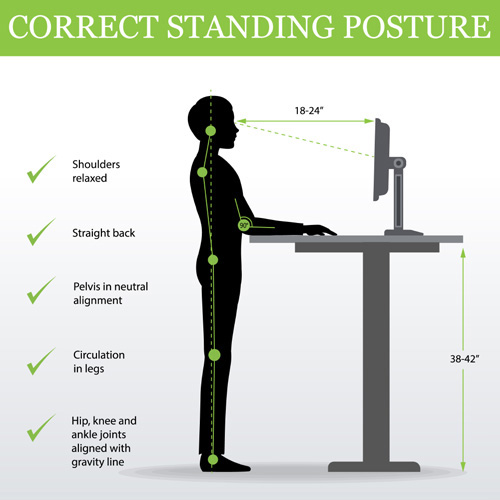
One of the strongest mechanical contributors to desk shrimp posture is monitor height. When your screen is too low, your head drops forward automatically. You're not being lazy, you're just following your eyes. Raise the top of your screen to roughly eye level, position it about an arm's length away, and you remove the main mechanical pull toward shrimping.
If you work on a laptop without a separate monitor, here is an uncomfortable truth: a laptop alone makes optimal positioning difficult. The screen and keyboard cannot both be in good positions at the same time. A laptop riser with a separate keyboard and mouse solves this problem.
The chair matters too. Sit all the way back into it. Let the lumbar support do its job. Your elbows should sit at roughly 90 degrees with your feet flat on the floor. Lean back slightly when you can. That slight recline improves breathing, reduces hip and lumbar load, and lets the chair back carry weight your muscles shouldn't have to.
Here's the goal: screen at eye level, elbows at 90 degrees, back supported, feet grounded. After that, movement matters more than any gadget. No chair or desk will save you if you stay frozen in one position for hours.


Set a timer for every 30 to 60 minutes. When it goes off, try these three exercises. The first two you can do without leaving your chair. The third one requires a wall, which is a good excuse to stand up and walk.
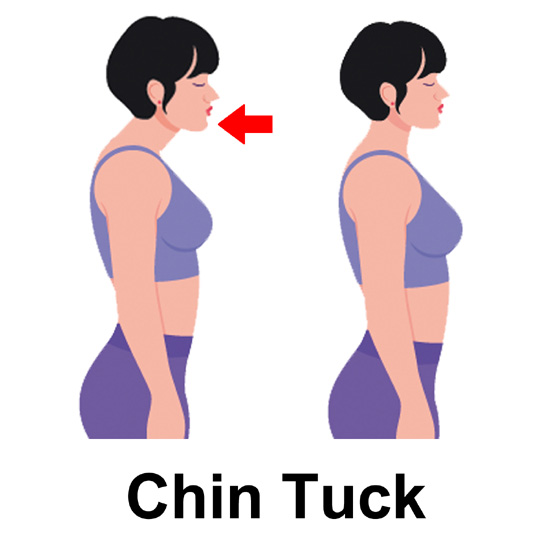
The chin tuck is the most important. Without lifting or dropping your chin, draw your head straight back until you feel a gentle stretch at the base of the skull. Think "tall, not tilted." Hold for two seconds, release, and repeat 10 times. This reactivates the deep neck flexors that weaken and elongate under desk shrimp conditions.
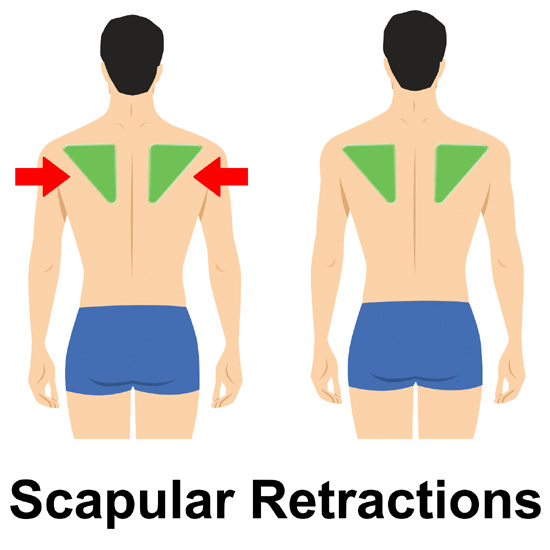
Scapular retractions take five seconds each. Sitting or standing, pull your shoulder blades together as if trying to hold a pencil between them. Hold two seconds, release. Repeat 10 times. This counters the rounded-shoulder position directly and can be done invisibly at your desk.
Wall angels come last. Stand with your back, head, and heels touching a wall. Arms bent to 90 degrees, palms forward. Slowly slide your arms up the wall and back down without letting your lower back peel away. This restores scapular control and opens the chest simultaneously. Do 10 repetitions.

In one randomized trial of office workers with chronic neck and shoulder pain, four weeks of consistent stretching done at least three times per week produced meaningful reductions in pain and improvements in neck function.
You do not need perfect posture. What you need is a workspace that fits you and a habit of moving regularly. Posture is not destiny. It is a load distribution issue, and the best antidote is simply refusing to stay in any one position for too long.
Unshrimp yourself. Your spine has been asking nicely for a while now.
Reference Links:
Internal Oblique and Transversus Abdominis Muscle Fatigue Induced by Slumped Sitting Posture after 1 Hour of Sitting in Office Workers
Pooriput Waongenngarm, Bala S Rajaratnam, Prawit Janwantanakul
Safety and Health at Work, Published 2016 Mar; 7
Click Here for the Study: https://doi.org/10.1016/j.shaw.2015.08.001
The Relationship Between Forward Head Posture and Neck Pain: a Systematic Review and Meta-Analysis
Nesreen Fawzy Mahmoud, Karima A Hassan, Salwa F Abdelmajeed, Ibraheem M Moustafa, Anabela G Silva
Current Reviews in Musculoskeletal Medicine, Published 2019 Dec;12(4):562-577.
Click Here for the Study: https://doi.org/10.1007/s12178-019-09594-y
The effectiveness of a neck and shoulder stretching exercise program among office workers with neck pain: a randomized controlled trial
Punjama Tunwattanapong, Ratcharin Kongkasuwan, Vilai Kuptniratsaikul
Clinical Rehabilitation, Published 2016 Jan;30(1):64-72.
Click Here for the Study: https://doi.org/10.1177/0269215515575747
Efficacy of Ergonomic Interventions on Work-Related Musculoskeletal Pain: A Systematic Review and Meta-Analysis
Weiner Santos, Carmen Rojas, Rui Isidoro, Alejandro Lorente, Ana Dias, Gonzalo Mariscal, María Benlloch, Rafael Lorente
Journal of Clinical Medicine, Published 2025 Apr 28;14(9):3034. doi: 10.3390/jcm14093034.
Click Here for the Study: https://doi.org/10.3390/jcm14093034
Call for a FREE Consultation (305) 296-3434
CAUTION: Check with your doctor before
beginning any diet or exercise program.
2/18/2026


