


Eating Habits Behind Nearly Six Million Deaths a Year
Three Food Habits Your Heart Wishes You’d Change
Nearly six million people die from cardiovascular disease every year in ways linked to what they eat. That figure comes from the Global Burden of Disease Study, one of the largest health research projects ever conducted. Scientists modeled dietary risk using data from 204 countries over 33 years and estimated that, in 2023, 5.91 million cardiovascular deaths were linked to a poor diet.
Three eating habits kept showing up at the top: too much sodium, too little fruit, and too few whole grains. The deaths were mostly from ischemic heart disease, which means the arteries supplying blood to the heart get blocked, and from stroke, which happens when blood flow to the brain is cut off. While rankings shift by region and income level, these three factors consistently dominate the global picture.
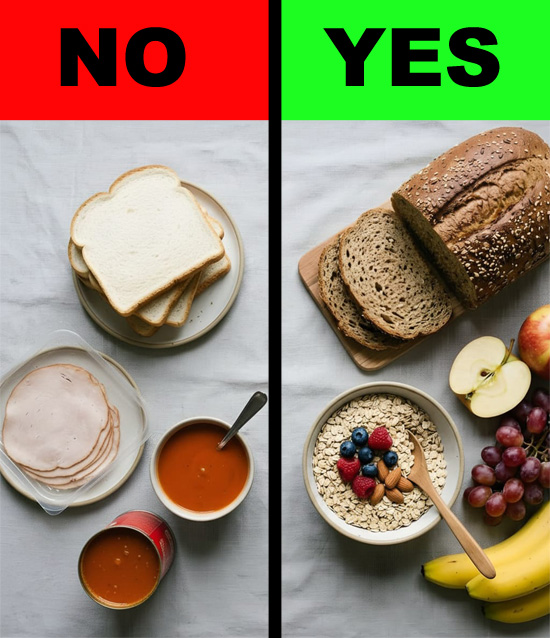
Sodium: the risk hiding in everyday food.
Sodium ranked first globally. Most people picture the salt shaker, but that's not where the problem lives. The bigger sources are bread, deli meats, canned soup, condiments, frozen meals, and restaurant food, all of which often contain added sodium to boost flavor and extend shelf life. Over time, too much sodium raises blood pressure, which increases strain on the heart and blood vessels. In the Global Burden of Disease analysis, high sodium was the single largest dietary contributor to cardiovascular deaths worldwide.
Low fruit intake: what's missing from the plate.
Low fruit consumption ranked second globally. In many low- and middle-income regions, lower intake of protective foods, including fruits, nuts, and whole grains, carries a particularly heavy share of the cardiovascular burden. Fruit provides potassium, fiber, and plant compounds called polyphenols that help protect blood vessels. A review of 16 long-term population studies published in the BMJ in 2014 found that people who ate more fruit had fewer deaths from cardiovascular disease and stroke. When fruit is not on the plate, it is often replaced by a packaged snack or sugary drink. That swap removes many protective compounds without reducing calories.
Low whole grain intake: what refining takes away.
Whole grains ranked third. Refining strips away the fiber and nutrients that help protect the heart and tends to allow blood sugar to rise faster after eating. A review of 45 studies published in the BMJ in 2016 found that people who ate more whole grains had lower rates of heart disease, stroke, and early death. Bread labeled "multigrain" or "wheat" can still be mostly refined flour. A true whole grain product is generally indicated by "100% whole grain" or "100% whole wheat" as the first ingredient.
The data from the United States looks slightly different. A Tufts University study published in JAMA in 2017 analyzed more than 700,000 cardiometabolic deaths, meaning deaths from heart disease, stroke, and type 2 diabetes, using 2012 US data. About 45 percent were estimated to be diet-related. Sodium ranked first there, too. But low nuts and seeds ranked second, ahead of fruit and whole grains. The Tufts team estimated that low nut and seed intake alone was tied to roughly 59,000 cardiometabolic deaths that year. American diets are, on average, high in processed foods, so adding something protective like nuts may show a larger measurable impact than it would elsewhere.
These figures come from modeling, not direct experiments. Researchers combine long-term population studies with national eating surveys to estimate how many deaths might be prevented if diets improved. Different teams using different methods keep arriving at the same short list. No model predicts what will happen specifically to YOU, but the consistency across all of them points in the same direction.
The research does not ask for a perfect diet. It points to a short list of habits that quietly add up over time. Most people are not undone by one bad meal. They are undone by the same small choices repeated every day.
Cut the sodium-heavy foods you eat most often. Add fruit where it replaces something worse. Swap one refined grain for a whole grain alternative.
Three changes. Not a new identity, just fewer of the habits that slowly move the odds in the wrong direction.
SPECIAL NOTE:
One finding buried in the data is worth noting. According to the Global Burden of Disease analysis focused on ischemic heart disease, the age-standardized death rate from diet-related ischemic heart disease fell by nearly 44 percent per 100,000 people between 1990 and 2023. Total deaths are still rising because the world's population is larger and older than it was in 1990. But the rate per person has dropped significantly, which means the efforts are working. The problem is that we need more of them.
Reference Links:
Cardiovascular diseases burden attributable to dietary risk factors in 204 countries and territories
Yayuan Mei, Xinyu Wang, Hui Xu, Peng Yin, Xiaohui Xu, Maigeng Zhou, Guoshuang Feng
The Innovation Nutrition, Published April 19, 2026
Click Here for the Study: https://doi.org/10.59717/j.xinn-nutri.2026.100015
Global Burden of Cardiovascular Disease from 1990 to 2019 Attributable to Dietary Factors
Bei Zhang, Liyuan Pu, Tian Zhao, Li Wang, Chang Shu, Shan Xu, Jing Sun, Ruijie Zhang, Liyuan Han
The Journal of Nutrition, Published 6, June 2023, Pages 1730-1741
Click Here for the Study: https://doi.org/10.1016/j.tjnut.2023.03.031
Global, regional, and national burden of cardiovascular disease due to dietary risks, 1990–2021
Yunfeng Yu, Danni Tan, Xinyu Yang, Jingyi Wu, Gang Hu, Weixiong Jian, Liping Wang
Frontiers in Cardiovascular Medicine, Published 05 February 2026
Click Here for the Study: https://doi.org/10.3389/fnut.2025.1623855
Global, regional and national burden of ischemic heart disease attributable to suboptimal diet, 1990–2023: a Global Burden of Disease study
(Please refer to original study for the LARGE number of contributors.)
Nature Medicine, Published 30 March 2026
Click Here for the Study: https://doi.org/10.1038/s41591-026-04250-8
Global burden of ischemic heart disease attributable to dietary factors: insights from the global burden of disease study 2021
Yan Wang, Daliang Yan, Wanzi Xu, Bo Min, Zhiwei Fan, Hong Su, Xue Zhao, Dongjin Wang, Yi Zhu
frontiers In Nutrition, Published 2025 Oct 2;12:1634566
Click Here for the Study: https://doi.org/10.3389/fnut.2025.1634566
Association Between Dietary Factors and Mortality From Heart Disease, Stroke, and Type 2 Diabetes in the United States
Renata Micha, Jose L. Peñalvo, Frederick Cudhea, Fumiaki Imamura, Colin D. Rehm, Dariush Mozaffarian
JAMA Network, Published Online: March 7, 2017
Click Here for the Study: https://jamanetwork.com/journals/jama/fullarticle/2608221
Fruit and vegetable consumption and mortality from all causes, cardiovascular disease, and cancer: systematic review and dose-response meta-analysis of prospective cohort studies
Xia Wang, Yingying Ouyang, Jun Liu, Minmin Zhu, Gang Zhao, Wei Bao, Frank B Hu
STUDYJOURNAL, Published 29 July 2014
Click Here for the Study: https://doi.org/10.1136/bmj.g4490
Whole grain consumption and risk of cardiovascular disease, cancer, and all cause and cause specific mortality: systematic review and dose-response meta-analysis of prospective studies
Dagfinn Aune, NaNa Keum, Edward Giovannucci, Lars T Fadnes, Paolo Boffetta, Darren C Greenwood, Serena Tonstad, Lars J Vatten, Elio Riboli, Teresa Norat
the bmj, Published 14 June 2016
Click Here for the Study: https://doi.org/10.1136/bmj.i2716
Global burden of ischemic heart disease attributable to dietary factors: insights from the global burden of disease study 2021
Yan Wang, Daliang Yan, Wanzi Xu, Bo Min, Zhiwei Fan, Hong Su, Xue Zhao, Dongjin Wang, Yi Zhu
Frontiers in Nutrition, Published 01 October 2025
Click Here for the Study: https://doi.org/10.3389/fnut.2025.1634566
Call for a FREE Consultation (305) 296-3434
CAUTION: Check with your doctor before
beginning any diet or exercise program.
4/27/2026


