


Hidden Muscles, Real Consequences
How to Fix the Pain Your Workout Keeps Ignoring
Last year a client came to me after two years of persistent knee pain. He had seen a doctor, bought new shoes, stretched his quads, and rested until the pain faded before training again. It always came back. Nobody had ever looked at his hip.
That story is not unusual. Chronic knee pain, nagging shoulder problems, and recurring back trouble often involve a common contributing factor. Often-overlooked muscles that never get trained because they don't look impressive in the mirror.
Pain is rarely that simple, and these muscles are only one piece of the picture. But they are a piece that most training programs ignore entirely. Three of them are worth knowing about right now.
Your Hip Stabilizer
Deep in your outer hip sits a muscle called the gluteus medius. Its job is to keep your pelvis level when you walk, run, or stand on one leg.
Think of it as a kickstand. When it is doing its job, the bike stays upright, weight is distributed evenly, and everything rolls smoothly. When the kickstand fails, the whole thing leans. The parts closest to the ground take the punishment.
In the body, that punishment lands at the knee. Every step where the hip drops shifts load through the knee at an angle it was not designed to handle repeatedly. Runners with IT band syndrome often demonstrate measurably weaker hip muscles on the affected side compared to healthy runners, and strengthening those muscles often leads to significant improvement.

A simple starting point takes two minutes. The exercise is called the side-lying hip abduction. Lie on your side and lift your top leg slowly, keeping your hips stacked. Do 15 repetitions, rest, and repeat. Keep your pelvis still throughout. As this gets easier, slow the tempo or add a resistance band above the knee.
Your Shoulder Anchor
Most people have felt it without knowing what it was. A catching, grinding sensation near the top of an overhead press. A shoulder that aches after a session that should have been routine. The serratus anterior is often somewhere in that story.
The muscle wraps around your ribcage and holds your shoulder blade flat against your back during pressing, reaching, and throwing. Most people have never trained it directly. When it's weak, the shoulder blade lifts away from the ribcage instead of staying anchored, and the joint above it loses its stable base. That can contribute to shoulder discomfort and pinching inside the joint, particularly in people who press or reach overhead regularly.

To train it, try the wall slide. Stand facing a wall with your forearms flat against it, elbows bent at 90 degrees. Slide your arms upward while pushing the wall away the entire time. That pushing motion is what activates the muscle. Three sets of 10 repetitions is enough to start.
Your Back's Foundation
Ask anyone who has dealt with recurring back pain and you will hear the same story. They hurt it, rested for two weeks, felt fine, went back to the gym, and threw it out again within a month. Sometimes the cycle repeats for years. Rest. Recover. Repeat.
Research offers a partial explanation for why. The multifidus runs along both sides of your lower spine and helps stabilize each vertebra while everything else moves around it. After an episode of low back pain, this muscle can shrink on the injured side. The pain resolves but the weakness does not, which may help explain why the back goes again so reliably once regular activity resumes.
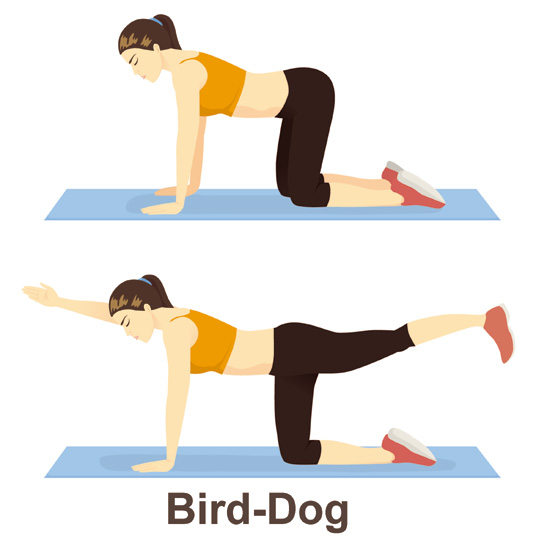
The bird-dog trains it without straining your back. From hands and knees, extend one arm and the opposite leg at the same time. Hold for three seconds, return slowly, and switch sides. Avoid letting your lower back arch or rotate. As the movement becomes comfortable, increase the hold time before adding any load.
Ten minutes added to two or three workouts per week is a strong start.
These are not glamorous exercises. Nobody is posting their bird-dog sets on social media. But the people who add this kind of work consistently are usually the ones still training without interruption five years from now, while everyone else is managing something.
Call for a FREE Consultation (305) 296-3434
CAUTION: Check with your doctor before
beginning any diet or exercise program.
5/11/2026


