


Marbled
Why aging muscle starts to look like a well-marbled steak, and how to stop it.
As you get older, fat slowly works its way into your muscles. Imagine a lean steak slowly turning marbled like a ribeye. That isn't just an analogy, it's what CT and MRI scans show as people age, especially when they're less active.
Scientists call this myosteatosis. It helps explain why so many people get weaker and less steady as they age, even when their weight barely changes.
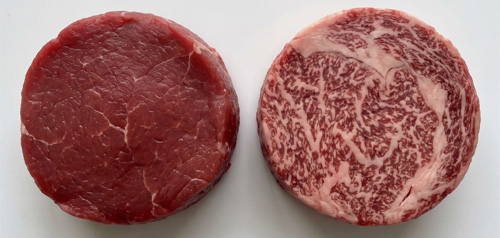
Picture two people with leg muscles the same size. One set is dense and lean. The other is laced with fat. In pants they look the same. But one of them stands up from a low chair without thinking. The other reaches for the armrest. That's the difference between muscle size and muscle quality.
Here's what that means for survival. A 2018 review pooled strength and death records from about two million people and found a clear pattern. People with greater strength were more likely to be alive at follow-up. In the studies that measured the legs specifically, higher knee strength came with about a 14 percent lower risk of dying from any cause. And strength tracked with survival more reliably than muscle size did. You can carry plenty of muscle and still be weak, and it's the weakness that shows up in the death records.
Studies that single out leg strength make the connection clearer still. In one study of men with peripheral arterial disease, (a circulation problem in the legs), the men with the weakest knees were nearly three times more likely to die than the strongest. The same pattern didn't hold for women in that study, but in the men, weak legs acted as an early warning years before the worst outcomes.
Now the part people find hardest to believe. Your legs may also have something to say about your brain. Researchers at King's College London tracked 324 women, most around age 55, for ten years. They measured leg power at the start, then tested memory and thinking a decade later. The women with more powerful legs at the start held onto more of their thinking ability, and brain scans suggested less age-related shrinkage. Because the study followed twins, the scientists could largely separate leg power from shared genes and upbringing.
Why can a few simple leg movements tell you so much? Because standing up draws on muscle, balance, nerves, and circulation all at once. A slower or shakier rise often reflects changes across several systems, not just the muscle.
Strength starts a slow slide in your 30s, and the losses speed up after 60. The thigh takes the hardest hit. In one comparison of healthy young and older men, the older group had lost about a quarter of their thigh muscle, with the quadriceps on the front of the thigh down about 30 percent.
Fat infiltration is part of why strength can fade even when the muscle is still there. You can keep most of your muscle and still get weaker, because the muscle you keep is marbled with fat and produces less force.
The payoff from exercising comes faster than people expect. Within weeks of training, strength climbs, well before the muscle looks any different. That early jump is mostly your nervous system learning to use the muscle you already have. Stairs feel easier. Balance improves too, which matters, because falls are a leading cause of injury death after 65.
If you think you're too old to start, look at the most famous study in this field. Researchers took frail nursing-home residents, average age 90, and trained them hard for eight weeks. Their leg strength rose by an average of 174 percent. People in their 90s, some using walkers, nearly tripled their leg strength.
The secret is simple. Make your legs work against real resistance, often, and slowly ask them for more.
-
Sit in a sturdy chair and stand back up without using your hands, ten or twelve times, and when it gets easy, slow the lowering or hold something heavy. Once you've built some basic strength, standing up quickly trains power.
-
Add step-ups onto a low box or the bottom stair, one leg at a time.
-
Carry a loaded grocery bag in each hand across the room and back.
-
Finish with calf raises.
A few moves, a few times a week, a little more each time.
Strong legs won't stop the clock. What they will do is widen the gap between the years you're alive and the years you're independent. In study after study, people with stronger legs are more likely to live longer, hold onto their thinking skills, and stay independent later in life.
Reference Links:
Muscular Strength as a Predictor of All-Cause Mortality in an Apparently Healthy Population: A Systematic Review and Meta-Analysis of Data From Approximately 2 Million Men and Women
Antonio García-Hermoso, Iván Cavero-Redondo, Robinson Ramírez-Vélez, Jonatan R. Ruiz, Francisco B. Ortega, Duck-Chul Lee, Vicente Martínez-Vizcaíno
ACRM Archives of Physical Medicine and Rehabilitation, Published October 2018
Click Here for the Study: https://doi.org/10.1016/j.apmr.2018.01.008
Leg strength predicts mortality in men but not in women with peripheral arterial disease
Nimarta Singh, BAa ∙ Kiang Liu, PhDa ∙ Lu Tian, ScDb ∙ Michael H. Criqui, MD, PhDc ∙ Jack M. Guralnik, MD, PhDd ∙ Luigi Ferrucci, MD, PhDd ∙ Yihua Liao, MSa ∙ Mary M. McDermott, MD
JVS Journal of Vascular Surgery, Published September 2010
Click Here for the Study: https://doi.org/10.1016/j.jvs.2010.03.066
Kicking Back Cognitive Ageing: Leg Power Predicts Cognitive Ageing after Ten Years in Older Female Twins
Claire J. Steves; Mitul M. Mehta; Stephen H.D. Jackson; Tim D. Spector
Gerontology, Published November 10 2015
Click Here for the Study: https://doi.org/10.1159/000441029
Thigh muscles are more susceptible to age-related muscle loss when compared to lower leg and pelvic muscles
Cas J. Fuchs, Remco Kuipers, Jan A. Rombouts, Kim Brouwers, Vera B. Schrauwen-Hinderling, Joachim E. Wildberger, Lex B. Verdijk, Luc J.C. van Loon
Experimental Gerontology, Published 31 March 2023
Click Here for the Study: https://doi.org/10.1016/j.exger.2023.112159
Skeletal muscle fat infiltration: Impact of age, inactivity, and exercise
R.L. Marcus, O. Addison, J.P. Kidde, L.E. Dibble, P.C. Lastayo
The Journal of nutrition, health and aging, Published May 2010, Pages 362-366
Click Here for the Study: https://doi.org/10.1007/s12603-010-0081-2
Heavy resistance training at retirement age induces 4-year lasting beneficial effects in muscle strength: a long-term follow-up of an RCT
Mads Bloch-Ibenfeldt, Anne Theil Gates, Karoline Karlog, Naiara Demnitz, Michael Kjaer, Carl-Johan Boraxbekk
BMJ Open Sport & Exercise Medicine, Published 18 June 2024
Click Here for the Study: https://doi.org/10.1136/bmjsem-2024-001899
High-Intensity Strength Training in Nonagenarians Effects on Skeletal Muscle
Maria A. Fiatarone, MD; Elizabeth C. Marks, MS; Nancy D. Ryan, DT Carol N. Meredith, PhD; Lewis A. Lipsitz, MD; William J. Evans, PhD
JAMA Network, Published Online: June 13, 1990
Click Here for the Study: https://doi.org/10.1001/jama.1990.03440220053029
A 30-s Chair-Stand Test as a Measure of Lower Body Strength in Community-Residing Older Adults
C. Jessie Jones, Roberta E. Rikli & William C. Beam
Research Quarterly for Exercise and Sport, Published online: 22 Feb 2013
Click Here for the Study: https://doi.org/10.1080/02701367.1999.10608028
Fat infiltration in skeletal muscle: Influential triggers and regulatory mechanism
Liyi Wang, Teresa G. Valencak, Tizhong Shan
iScience - A Cell Press Journal, Published March 15, 2024
Click Here for the Study: https://doi.org/10.1016/j.isci.2024.109221
Call for a FREE Consultation (305) 296-3434
CAUTION: Check with your doctor before
beginning any diet or exercise program.
7/13/2026


