


A Little Rusty? It Might Be Your Iron.
You're tired all the time. Climbing the stairs leaves you winded. Your workouts feel harder than they should. So you get blood work, and your doctor says everything looks normal.
Lots of things can cause those symptoms, including poor sleep, stress, and thyroid problems. Low iron is another, and it can be missed even when a lab report says normal. On September 16th, the the American Society of Hematology (ASH) recommended new, higher cutoffs to help catch it.
Here's how low iron hides behind a normal test.
Your body uses iron to make red blood cells, which carry oxygen to your muscles and brain. It keeps extra iron stored away, like food in a pantry.
When you don't get enough iron, your body starts using up what's in the pantry. For a while, everything looks normal. Your body keeps making healthy red blood cells, so a regular blood test comes back fine. But the pantry is getting emptier, and you can start feeling tired and worn down long before it's empty.
A ferritin test checks how full your pantry is. That's why it can catch low iron before a regular blood test does.
Why "normal" can be misleading.
The normal range on a lab report and the cutoff for diagnosing a health problem are built for different jobs. A normal range shows where most healthy people's results land. A diagnostic cutoff marks the point where a problem is likely.
With iron, the gap between those two can be large, because low iron is so common. An estimated 1 in 7 adults is low on iron, and so are about 4 in 10 women of childbearing age.
For decades, a common cutoff for low iron was a ferritin of about 15, the number used by the World Health Organization. Research published this year suggests 15 was too low.
Scientists looked for the point where the body starts struggling to make healthy red blood cells because it's short on iron. For men, and women past menopause, that point was about 33. For women who still get periods, it was about 25.
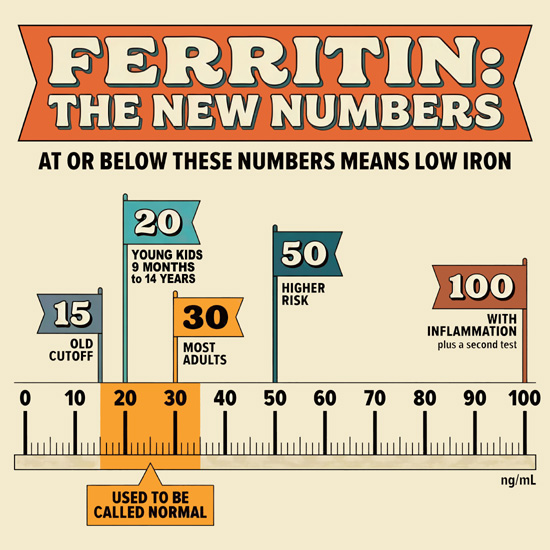
The new numbers.
Here are the new guidelines. For most adults, including pregnant women and women who get periods, a ferritin of 30 or lower indicates you might have low iron. For children 9 months to 4 years old, the cutoff is 20. For women with heavy periods, pregnant women who are already anemic, and some others at higher risk, doctors may use 50.
Inflammation makes things trickier. Long-term illnesses like cancer, Crohn's disease, and some infections can push ferritin up even when iron is low, like a fuel gauge that reads higher than it should. So for adults who are anemic and have inflammation, ASH recommends adding a second test called transferrin saturation, which shows how much iron is moving through your blood. Low iron may be the problem if ferritin is under 100 or transferrin saturation is under 20%. Only one has to be low.
What this doesn't mean.
These cutoffs are recommendations, not hard rules. The experts who wrote them said much of the research behind them isn't as strong as they'd like, and the advice may change as more studies come in.
Don't start taking iron just because you're tired. Too much iron can build up and damage your liver, heart, and other organs, and some people are born with a condition that makes them absorb too much. Get tested and talk to your doctor first.
If you're a man, or a woman who has gone through menopause, and you turn out to be low on iron, your doctor will want to know why. Sometimes the cause is slow bleeding in the stomach or intestines that you can't see. Other times it's trouble absorbing iron from food.
What to do.
Many labs haven't updated their reports yet, so a ferritin of 18 might still be marked normal. ASH is asking labs to change that.
Until they do, don't stop at "normal." Ask for your actual ferritin number. If it's 30 or lower, ask your doctor whether low iron could be part of the problem. Do the same if you're always tired and you have heavy periods, are pregnant, eat little or no meat, give blood often, or have a long-term illness. If you're anemic and have a condition that causes inflammation, ask about transferrin saturation too.
Normal on paper doesn't always mean normal for you.
Reference Links:
American Society of Hematology 2026 guidelines for diagnosis of iron deficiency
Jacquelyn M Powers, Ming Yeong Lim, Maureen O. Achebe, Imo J Akpan, Michael Auerbach, Megan C Brown, Maria Paula Cardenas, Caroline Cromwell, Thomas G. DeLoughery, Robert E. Fleming, Martina Fraga, George Goshua, Paula D. James, Adam K Lewkowitz, Jori Ellen May, Grace Nnadozie, Frances Ogunnaya, Guillermo J. Ruiz-Arguelles, Michelle Sholzberg, Layla Van Doren, Angela C. Weyand, Michelle Paula Zeller, Muayad Azzam, Ali Choaib, Qais Hamarsha, Hassan Kawtharany, Jana Khawandi, Reem A. Mustafa
ASH Publications Blood Advances, Published September 16, 2026
Click Here for the Study: https://doi.org/10.1182/bloodadvances.2025015950
ASH Sets New Standards for Diagnosing Iron Deficiency
Claire Whetzel
American Society of Hematology, Published September 16, 2026
Click Here for the Study: https://www.hematology.org/newsroom/press-releases/2026/ash-sets-new-standards-for-diagnosing-iron-deficiency
Physiologically based serum ferritin thresholds for iron deficiency in US older adolescents and adults
Zuguo Mei, O. Yaw Addo, Maria Elena D. Jefferds, Gary M. Brittenham
ASH Publications - blood RCI red cells & iron, Published March 2026
Click Here for the Study: https://doi.org/10.1016/j.brci.2025.100029
Call for a FREE Consultation (305) 296-3434
CAUTION: Check with your doctor before
beginning any diet or exercise program.
9/21/2026


