Two Simple Tests to Check for Muscular Balance
A well-rounded workout trains opposing muscles, like chest and back or biceps and triceps. The problem is that it's easy to focus on the muscles you see in the mirror. A lot of beginners chase a bigger bench press and give their back much less attention.
Measuring muscle balance precisely takes lab equipment. But two simple checks can give you a rough idea of whether something is worth paying attention to. Think of them as a first look, not a diagnosis.
Check One: Bench Press Versus Pull-Up
This check is for people who already do bench presses and pull-ups regularly. If you're new to either lift, skip it for now.
In 2004, researchers at Edith Cowan University in Australia tested trained male rugby league players on two lifts. They measured the most weight each player could bench press one time. Then they measured the most weight each player could lift in one pull-up, counting their body weight plus any weight hanging from a belt. On average, the two numbers came out almost exactly the same.
That gives you a rough rule of thumb. Your pushing and pulling strength should be in the same neighborhood.
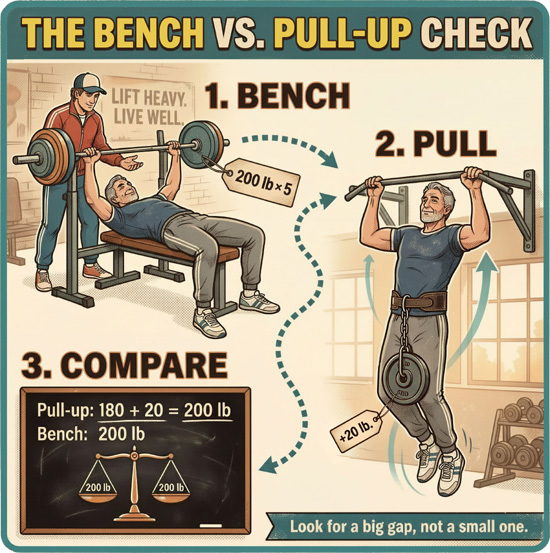
Testing a true one-rep max isn't a good idea for most people, so try a heavy set of five instead. Find the most you can bench press for five good reps, with a spotter. Then find the most you can pull up for five good reps. Add your body weight to any weight hanging from a dip belt, which is a belt with a chain for attaching weight plates. Use strict pull-ups, with no swinging or kicking.
Say you weigh 180 pounds and bench 200 pounds for five reps. Five pull-ups with about 20 pounds attached would put you in the same range.
Don't treat this as an exact test. The study used one-rep maxes, not sets of five, and it looked at a very specific group of athletes. Several things can throw the numbers off. Body weight is the big one. In a pull-up, you lift your whole body, so heavier people often struggle with pull-ups even when their back is strong. What you practice matters too. If you bench every week and rarely do pull-ups, you'll be better at the bench.
So look for a big gap, not a small one. If your bench press is far ahead, check your workouts. If you're doing a lot more pushing exercises than pulling exercises, like rows and pulldowns, add more pulling work.
Check Two: Left Leg Versus Right Leg
Most people have a stronger side. Small differences are normal. A bigger gap that shows up every time you test may be worth working on.
Skip this check if you have knee, ankle, or hip pain, swelling, a recent injury or surgery, or balance problems. Stop if anything hurts or feels unstable.
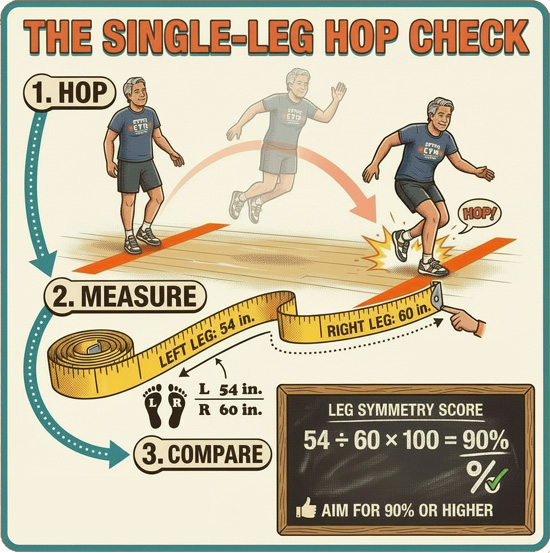
Stand on one leg with your toes behind a line. Hop forward as far as you can and land on the same leg, holding the landing steady for a moment. Measure the distance from the line to your heel. Then do the same on your other leg. Take a couple of practice hops on each side first, then use your best hop on each leg.
To compare, divide the shorter hop by the longer hop and multiply by 100. If one leg goes 54 inches and the other goes 60, that's 90%.
You may hear that anything under 90% is a problem. That number comes from physical therapy after knee surgery, where it's one of many checks used before athletes return to sports. It isn't a danger line for healthy people. A review of 28 studies found that uneven legs didn't reliably predict who would get hurt.
A hop also measures more than strength. Balance, coordination, and confidence all play a part. So think of the results as your shorter-hop side and your longer-hop side, not a weak leg and a strong leg.
If hopping isn't right for you, try this instead. Stand next to a kitchen counter with a hand resting on it for balance. Slowly sit back onto a sturdy chair using one leg, then stand back up. Count how many you can do with good control, then switch sides. Don't use the 90% math for this one. Just look for an obvious difference.
Bonus Check: Size isn't the Same as Strength
Flex both arms and one bicep may look a little bigger than the other. That's common. Your dominant side often gets more use, and genetics play a part too. A small difference in how your muscles look usually isn't a concern. A noticeable difference in strength or performance is more useful to keep an eye on.
Front-to-back Training
One simple way to keep opposing muscles balanced is front-to-back training. Do a set for one muscle group, then go right into a set for the opposing group. Rest after you finish both, then repeat the pair. Good pairs include a chest press with a seated row, a biceps curl with a triceps pushdown, and a leg extension with a leg curl.
The biggest benefit is time. Because you do two sets between each rest, workouts go faster. Research shows this kind of pairing shortens workouts, and the long-term studies so far show similar strength and muscle gains to regular sets, though there aren't many of them yet. In studies of opposing-muscle pairs, people were sometimes able to squeeze out a few more reps than with regular sets. The trade-off is that paired sets tend to feel harder.
Pairing exercises doesn't fix an imbalance on its own. If one area is behind, it needs enough work to catch up. For example, if your pulling is lagging, you might add an extra set of rows each workout.
For single-arm or single-leg exercises, start with your less capable side. Whatever reps it can do with good form, stop your other side at the same number. Over time, the gap usually shrinks.
If a difference between sides comes with pain, a joint that gives way, or weakness that's getting worse, don't try to train through it. See a doctor or physical therapist.
Try these checks and see what your body tells you.
Reference Links:
Superset Versus Traditional Resistance Training Prescriptions: A Systematic Review and Meta-analysis Exploring Acute and Chronic Effects on Mechanical, Metabolic, and Perceptual Variables
Xing Zhang, Jonathon Weakley, Hansen Li, Zhaoqian Li & Amador García-Ramos
Sports Medicine, Published 04 February 2025
Click Here for the Study: https://doi.org/10.1007/s40279-025-02176-8
Agonist-antagonist paired set resistance training: a brief review
Daniel W Robbins, Warren B Young, David G Behm, Warren R Payne
Journal of Strength and Conditioning Research, Published 24(10):p 2873-2882, October 2010
Click Here for the Study: https://doi.org/10.1519/jsc.0b013e3181f00bfc
Association between Inter-Limb Asymmetries in Lower-Limb Functional Performance and Sport Injury: A Systematic Review of Prospective Cohort Studies
Yanfei Guan, Shannon S D Bredin, Jack Taunton, Qinxian Jiang, Nana Wu, Darren E R Warburton
Journal of Clinical Medicine, Published 2022 Jan 12
Click Here for the Study: https://doi.org/10.3390/jcm11020360
Association of past 12-month sports injury history with hop limb symmetry index in physically active university students: a cross-sectional study of field-based functional asymmetry profiles
Jie Gao, He Chen, Kaibin Fan
Frontiers in Public Health, Published 02 July 2026
Click Here for the Study: https://doi.org/10.3389/fpubh.2026.1868536
An analysis of the ratio and relationship between upper body pressing and pulling strength
Daniel G Baker, Robert U Newton
Journal of Strength and Conditioning Research, Published 2004 Aug;18
Click Here for the Study: https://pubmed.ncbi.nlm.nih.gov/15320678/
Call for a FREE Consultation (305) 296-3434
CAUTION: Check with your doctor before
beginning any diet or exercise program.
1/16/2011
Updated 9/16/2026