


The Body String Test
Waist to Height Ratio: The Simplest Health Check You'll Ever Do
Grab a piece of string. In less than a minute, it can tell you something your bathroom scale never will.
Cut a piece of string as long as you are tall. Fold it in half, then wrap that doubled-over length around your waist, keeping it snug without pulling it tight. If the ends overlap, your waist is less than half your height. That's a good sign. If they just meet, you're right at the recommended limit. If they don't reach, your waist is more than half your height, and that may be a warning sign of increased health risk.
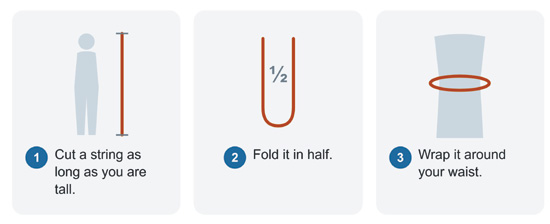

It's a simple trick called the Body String Test.
Where It Came From
The idea comes from British nutrition scientist Margaret Ashwell of Oxford Brookes University. For decades she has pushed one simple message: keep your waist to less than half your height. Doctors call it the waist-to-height ratio. UK health guidelines now use it for adults and for children 5 and older. In 2025, an international commission of 58 health experts included it among the measurements doctors can use alongside BMI to help identify excess body fat.
What BMI Misses
Body Mass Index, or BMI, only looks at your height and weight. It can't tell muscle from fat, and it can't tell where your fat sits.
So a muscular person can land in the "overweight" or even "obese" range without carrying an unhealthy amount of body fat. The string test focuses on your waist instead of your total weight.
BMI can also miss people who carry too much fat around their middle. You've seen them. Skinny arms and legs, but a gut. Fat around the belly can be more concerning. Some of it lies deep inside, wrapped around your liver and other organs, and it's closely tied to heart disease, type 2 diabetes and high blood pressure. The string test flags a waist that's large for your height, something BMI alone can't show.
The Evidence
In 2014, Ashwell and a team at City University London analyzed decades of British health and death records. Waist-to-height ratio predicted early death better than BMI.
They also estimated what that could mean in years of life. For a 30-year-old nonsmoking man who's 5 feet 10 inches tall, the researchers calculated that a 42-inch waist, compared with 35 inches, could mean about 1.7 fewer years of life. For a nonsmoking woman the same age who's 5 feet 4 inches tall, a waist of about 38 inches, compared with 32, was associated with roughly 1.4 fewer years. These are population estimates that assume a person stays at that size, not predictions for any one person.
Newer research points the same way. A 2026 study involving more than 19,000 Americans found that waist-to-height ratio identified people with high blood pressure better than BMI. Researchers tested several cutoffs, but their findings support the idea behind the string test: your waist matters.
Want an Exact Number?
Measure your height barefoot against a wall. Then measure your waist halfway between the bottom edge of your last rib and the top of your hip bone. Keep the tape level and snug against bare skin. Breathe out normally, and no sucking in!

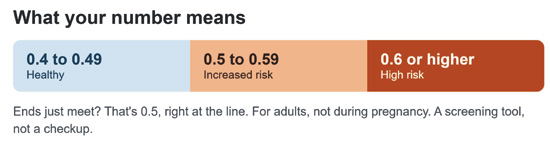
Divide your waist by your height. UK guidelines use three ranges for adults. From 0.4 to 0.49 is healthy. From 0.5 to 0.59 means increased risk. At 0.6 or higher, the risk is high. A ratio below 0.4 isn't necessarily better, either. Someone can have a small waist and still be underweight or have too little muscle.
What the String Can't Tell You
The string can't see inside your body, so two people with the same waist can carry different amounts of deep fat. It isn't meant for pregnant women, and it adds less useful information for adults with a BMI of 35 or higher. It also doesn't replace a checkup. Blood pressure, cholesterol and blood sugar tests still tell you things a string can't. For a second opinion, try our waist-to-hip ratio test in "Your Waist Knows Something Your Scale Doesn't."
The Best Part
For most adults, height changes far less than waist size, so the string is an easy way to track progress. Exercise can reduce deep belly fat even without weight loss, so your waist may shrink before the number on your scale moves.
It's fast, it's free, and research suggests it can spot health risks BMI misses.
So how well did your string fit?
Reference Links:
A proposal for a primary screening tool: `Keep your waist circumference to less than half your height’
Margaret Ashwell & Sigrid Gibson
BMC Medicine, Published 07 November 2014
Click Here for the Study: https://doi.org/10.1186/s12916-014-0207-1
Waist-to-Height Ratio Is More Predictive of Years of Life Lost than Body Mass Index
Margaret Ashwell, Les Mayhew, Jon Richardson, Ben Rickayzen, Editor: Martin Young
PLoS ONE, Published 2014 Sep 8
Click Here for the Study: thttps://doi.org/10.1371/journal.pone.0103483
Overweight and obesity management - NICE guideline Reference number:NG246
NICE National Institute for Health and Care Excellence, Published 14 January 2025
Click Here for the Report: https://www.nice.org.uk/guidance/NG246/chapter/identifying-and-assessing-overweight-obesity-and-central-adiposity
Definition and diagnostic criteria of clinical obesity
Francesco Rubino, David E Cummings, Robert H Eckel, Ricardo V Cohen, John P H Wilding, Wendy A Brown, Fatima Cody Stanford, Rachel L Batterham, I Sadaf Farooqi, Nathalie J Farpour-Lambert, Carel W le Roux, Naveed Sattar, Louise A Baur, Katherine M Morrison, Anoop Misra, Takashi Kadowaki, Kwang Wei Tham, Priya Sumithran, W Timothy Garvey, John P Kirwan, José-Manuel Fernández-Real, Barbara E Corkey, Hermann Toplak, Alexander Kokkinos, Robert F Kushner, Francesco Branca, Jonathan Valabhji, Matthias Blüher, Stefan R Bornstein, Harvey J Grill, Eric Ravussin, Edward Gregg, Noor B Al Busaidi, Nasreen F Alfaris, Ebaa Al Ozairi, Lena M S Carlsson, Karine Clément, Jean-Pierre Després, John B Dixon, Gauden Galea, Lee M Kaplan, Blandine Laferrère, Martine Laville, Soo Lim, Jesús R Luna Fuentes, Vicki M Mooney, Joseph Nadglowski Jr, Agbo Urudinachi, Magdalena Olszanecka-Glinianowicz, An Pan, Francois Pattou, Philip R Schauer, Matthias H Tschöp, Maria T van der Merwe, Roberto Vettor, Geltrude Mingrone
Lancet Diabetes Endocrinol, Published 2025 Jan 14
Click Here for the Study: https://doi.org/10.1016/S2213-8587(24)00316-4
Novel Waist-to-Height Ratio Estimated Fat Mass Pediatric Cut-offs Predict Hypertension Better than Body Mass Index in Multiracial United States Youths and Adults: The National Health and Nutrition Examination Survey 2015–2023 Cycle
Mahidere W Ali, Douglas R Corsi, Andrew O Agbaje
JN The Journal of Nutrition, Published online 18 February 2026,
Click Here for the Study: https://doi.org/10.1016/j.tjnut.2026.101426
A systematic review and meta-analysis on the effects of exercise training versus hypocaloric diet: distinct effects on body weight and visceral adipose tissue
Verheggen, RJ, Maessen, MF, Green, DJ, Hermus, AR, Hopman, MT and Thijssen, DHJ
Obesity Reviews, Published 23 May 2016
Click Here for the Study: http://dx.doi.org/10.1111/obr.12406
Waist-to-height ratio is a better screening tool than waist circumference and BMI for adult cardiometabolic risk factors: systematic review and meta-analysis
M. Ashwell, P. Gunn, S. Gibson
Obesity Reviews, Published 23 November 2011
Click Here for the Study: https://doi.org/10.1111/j.1467-789X.2011.00952.x
Call for a FREE Consultation (305) 296-3434
CAUTION: Check with your doctor before
beginning any diet or exercise program.
7/5/2015
Updated 10/23/2026


