


How to Set Realistic Weight Loss Goals
This article has been UPDATED.
Please skip to the UPDATE section for the full story.
A realistic weight loss goal can mean the difference between failure and success. When you put a number on what you want to lose, that number must be both healthy and achievable. So many times I’ve seen people give up or fail, because they decided on a goal that’s completely out of touch with what would be appropriate.
Step one, come up with a number that’s right for you. Consider what you’re going to use as a baseline. The traditional approach is something pioneered by insurance companies. They produced “height-weight” tables. You choose the table for your gender, and then look up your height. Beside that is a range of weights, from low to high that are considered healthy.
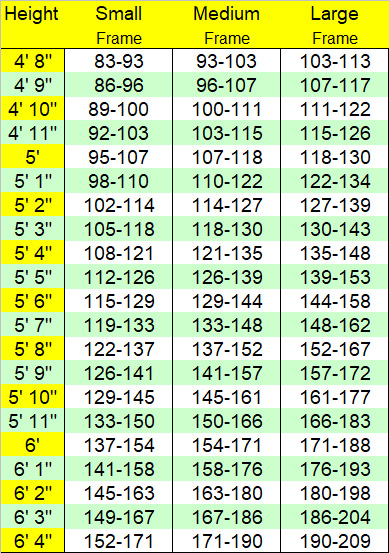
This table was designed by calculating the healthy range of weights using the Body Mass Index (BMI) information for the corresponding heights. Then the healthy range (from 19 to 25) was divided into three groups, small, medium and large.
The range is quite broad. So step two is finding out where in that range you fit. You do that by measuring your body frame. If you have a larger body frame you should keep your weight on the upper end of the acceptable range. If you have a smaller body frame, a healthy weight is probably on the lower end of the range.
To measure your frame, check your wrist size. Wrap your middle finger and thumb around your wrist. If the fingers overlap you're small-boned and should be on the lighter end of the scale. If your fingers just touch, you'll probably be best around the middle. If your fingers don't touch at all, your ideal body weight is probably at the higher end of the scale.
Once you know your frame size and where in the range your weight should fall, you have a starting number. But that’s not necessarily the best number for YOU. Step three requires you consider how many times you’ve tried to lose weight in the past.
It might seem a little crazy to consider past efforts, but it’s critical that you do. One or two previous attempts may not make much of a difference, but if you’ve lost and regained weight five or more times, you may be dealing with a damaged metabolism.
In a process called adaptive thermogenesis, your body quits responding to weight loss efforts and essentially keeps you stuck at a higher level. If you’ve spent years yo-yo dieting, consider a weight loss goal that gets you to between 60 and 80% of your ideal.
Step four; you need to take an honest appraisal of your exercise goals. Strength training at least twice a week and aerobic exercise three times weekly is considered the minimum you should try to accomplish. But you might not be willing to commit to that.
Be honest with yourself. If you can’t commit to the minimum, give yourself a walking goal. Pledge that you’re going to walk at least three times a week, for a minimum of 30 minutes. After you’ve done that for a few months, you can look at expanding into something more vigorous.
If you’re only able to commit to walking or no exercise at all, take your weight loss goal and cut it down by another 20%. Exercise doesn’t do a whole lot to help you lose the initial weight, but it’s a big help in boosting your metabolism so you can keep it off. Without an exercise commitment, only plan on losing 50-70% of what you need to reach your ideal.
Remember that at some point you will need to introduce strength training into your routine. Aerobic exercise helps with your cardiovascular system, but it doesn’t build muscle. We lose about 10% of our muscle mass each decade. Only physical labor (lifting heavy things) or a weight-training workout can slow or reverse that decline.
After you achieve that first weight loss goal, you need to learn how to keep your body at that level. Spend six to nine months doing weight maintenance and getting used to your new lighter self. Only after that lower weight becomes your new normal, should you once again re-evaluate where you are and start making new goals.
UPDATE: 9/22/2025
Weight Loss Goals: What’s Changed Since This Was Originally Published
Eight years ago, I wrote about setting realistic weight loss goals using BMI charts and frame size measurements. A lot of information has changed since then, and it’s time for an update.
Science has progressed beyond the simple height-weight calculations we once relied on. Here’s what we know now, along with better ways to measure your progress.
What We Got Wrong
The BMI approach I recommended has serious flaws. BMI alone doesn’t reliably predict health for everyone, especially active people with more muscle mass. While BMI still shows population-level risks for conditions like diabetes and sleep apnea at higher levels, it fails as an individual health predictor. The wrist measurement method has limited scientific validation and poor agreement with more established measures of frame size.
What We Got Right
Repeated weight cycling is still associated with a higher body fat percentage, more visceral fat, and an increased risk of insulin resistance in some individuals.
Skip the BMI calculator. Focus on these better ways to measure success.
Waist circumference is a simple starting point. Men should aim for a waist measurement of 40 inches or less, and women should aim for 35 inches or less. This measurement predicts health risks more accurately than BMI for many individuals. Body fat percentage is emerging as a more useful measure, especially for women, as abdominal fat risk varies by ethnicity and age.
Track body composition changes. Many smart scales now estimate body fat and muscle mass. While these aren’t as precise as DEXA scans or clinical methods, they’re useful for tracking trends over time. Focus on the direction of change rather than exact numbers.
Monitor functional improvements. Notice your energy levels, sleep quality, and how easily you climb stairs. These changes often happen before the scale moves and matter more for daily life.
Watch health markers. Blood pressure, blood sugar, and cholesterol levels respond to modest weight loss more dramatically than the scale suggests.
Here are some updated goal-setting guidelines.
Start with 5-10% of your current weight. This modest loss delivers significant health benefits without the all-or-nothing pressure that derails most attempts.
Your metabolism does adapt during weight loss, but the effect is typically around 100-150 calories per day for most people. That’s manageable, not catastrophic.
Multiple previous failed attempts don’t mean you need dramatically lower goals. They suggest you need a different approach focused on sustainable habits rather than aggressive restriction.
Being honest about exercise commitments remains crucial. Current guidelines recommend 150-300 minutes of moderate physical activity per week, with higher amounts supporting additional weight loss and long-term maintenance. Strength training twice weekly helps preserve muscle during weight loss. The key is any safe movement that you’ll actually do consistently, including walking, cycling, swimming, or gentle strength training.
Plan to spend at least 6 months, and sometimes up to a year, stabilizing at your new weight before attempting further loss.
Focus on health improvements rather than reaching an arbitrary number on the scale. BMI remains useful for population-level screening; however, for individuals, waist circumference, body fat percentage, and health markers are more effective targets. Set modest initial goals and build sustainable habits.
The goal isn’t perfection. It’s finding a weight you can maintain while living a life you enjoy.
Reference Links:
Body Mass Index vs Body Fat Percentage as a Predictor of Mortality in Adults Aged 20-49 Years
Arch G. Mainous, Lu Yin, Velyn Wu, Pooja Sharma, Breana M. Jenkins, Aaron A. Saguil, Danielle S. Nelson and Frank A. Orlando
The Annals of Family Medicine, Published July 2025, 23
Click Here for the Study: https://www.annfammed.org/content/23/4/337
Comparison of determinants of frame size in older adults
Mary C Mitchell, PhD, RD
Journal of the Academy of Nutrition and Dietetics, Published January 1993
Click Here for the Study: https://www.jandonline.org/article/0002-8223(93)92131-G/abstract
Wrist Circumference and Frame Size Percentiles in 6-17-Year-Old Turkish Children and Adolescents in Kayseri
Ahmet Öztürk, Betül Çiçek, M Mümtaz Mazıcıoğlu, Gökmen Zararsız, Selim Kurtoğlu
JCRPE Journal of Clinical Research in Pediatric Endocrinology, Published 2017 Dec 15
Click Here for the Study: https://pmc.ncbi.nlm.nih.gov/articles/PMC5785639/
Comparing waist circumference with body mass index on obesity-related cancer risk: a pooled Swedish study
Ming Sun, PhD, Christel Häggström, PhD, Marisa da Silva, PhD, Innocent B Mboya, PhD, Ylva Trolle Lagerros, PhD, Karl Michaëlsson, PhD, Sven Sandin, PhD, Jerzy Leppert, PhD, Sara Hägg, PhD, Sölve Elmståhl, PhD, Patrik K E Magnusson, PhD, Stefan Söderberg, PhD, Weiyao Yin, PhD, Abbas Chabok, PhD, Angela Wood, PhD, Tanja Stocks, PhD, Josef Fritz, PhD
JNCI: Journal of the National Cancer Institute, Published 28 March 2025
Click Here for the Study: https://doi.org/10.1093/jnci/djaf075
WHO guidelines on waist circumference and physical activity and their joint association with cancer risk
Patricia Bohmann, Michael J Stein, Amina Amadou, Hansjörg Baurecht, Béatrice Fervers, Emma Fontvieille, Heinz Freisling, Christine Friedenreich, Julian Konzok, Laia Peruchet-Noray, Michael F Leitzmann, Anja M Sedlmeier, Andrea Weber
British Journal of Sports Medicine, Published January 22, 2025
Click Here for the Study: https://bjsm.bmj.com/content/59/6/360
Body-weight Cycling and Risk of Diabetic Kidney Disease in People With Type 1 Diabetes in the DCCT/EDIC Population
Marion Camoin, Kamel Mohammedi, Pierre-Jean Saulnier, Samy Hadjadj, Jean-François Gautier, Jean-Pierre Riveline, Nicolas Venteclef, Louis Potier, Gilberto Velho
The Journal of Clinical Endocrinology & Metabolism, Published Volume 110, Issue 10, October 2025
Click Here for the Study: https://doi.org/10.1210/clinem/dgae852
Weight Loss Patterns and Outcomes Over 12 Months on a Commercial Weight Management Program (CSIRO Total Wellbeing Diet Online): Large-Community Cohort Evaluation Study
Gilly A Hendrie; Danielle L Baird; Genevieve James-Martin; Emily Brindal; Paige G Brooker
JMIR Journal of Medical Internet Research, Published 15.Jan.2025
Click Here for the Study: https://www.jmir.org/2025/1/e65122/
Call for a FREE Consultation (305) 296-3434
CAUTION: Check with your doctor before
beginning any diet or exercise program.
12/9/2017
Updated 9/22/2025


