


Diverticulitis and the Western Diet
The Fiber Connection
There is a medical condition that’s extremely rare in Americans under 30, but it occurs in about 60% of adults over 60. It’s called diverticulosis. You can skip the following three paragraphs if you’re familiar with the problem. For everyone else, here’s a simplified explanation.
WHAT IS DIVERTICULITIS?
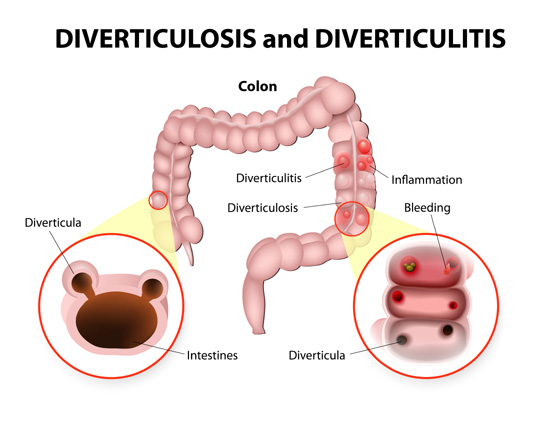
Pockets or bulges can form on the wall of your large intestine, also called your colon. Those bulges are called diverticula. Think about blowing up a long balloon and then squeezing it in different places to make a bubble pop out. In your colon, when you experience pressure, you get pockets or bulges that form in the weakened areas.
If you have diverticuLOSIS, that’s a confirmation that you have those bulges or pockets in your colon. You don’t need to have symptoms; most people don’t. It simply indicates they’re there.
You’re diagnosed with diverticuLITIS once any site gets inflamed, swells or is infected. You might feel pain, nausea, fever or other symptoms.
DEALING WITH DIVERTICULITIS
For a problem that affects so many people, you would assume it’s always been an issue, but you’d be wrong. According to a study published in the British Medical Journal in 1971, “...the term “Diverticulosis” first appeared in 1914. As recently as 1916, the disease was not important enough to merit a mention in textbooks. This dramatic increase in incidence occurred in only 70 years and cannot possibly be explained on a genetic basis. We believe that... the colon’s environment has changed and that diverticula are caused by the diet of so-called ‘civilized’ countries.”
In 1976 the Nurses’ Healthy Study was begun tracking the diet and health of 50,019 participants. After 24 years, the results were clear. The people who had the highest fiber intake had the lowest incidences of diverticulitis.
But it wasn’t just any fiber; it was insoluble fiber that helped. There are two primary types of fiber.
Insoluble fiber helps move things along through your digestive system, providing a good laxative action. It also increases the bulk of your stool, helping people who have constipation or irregular stool problems.
This was the fiber found to protect against diverticulitis. You can get insoluble fiber in your diet by eating dried peas and beans, nuts, vegetables, wheat bran and whole-wheat flour.
Soluble fiber slows digestion and absorption of glucose (sugar), keeping blood sugar levels even. It can also minimally help reduce blood cholesterol levels. This type of fiber DID NOT protect against diverticulitis, but surprisingly the FOODS with this type of fiber DID help.
People who had diets higher in whole fruits had much lower incidences of diverticulitis. You can find sources of soluble fiber in apples, barley, beans, carrots, citrus fruits, lentils, nuts, oats and oatmeal, peas, psyllium and seeds. Avoid fruit juices; they don’t provide any protective benefit.
What does that mean? ALL higher fiber foods provide protection against diverticulitis, either through the fiber type or some other nutritional benefit of the food itself.
After learning all that, what do many doctors recommend after diagnosing someone with diverticulitis? They suggest you eat A LOW FIBER DIET.
Imagine if someone walked into my training facility and they’ve never worked out. They had very little strength, problems with their balance, and difficulty moving around. Now imagine if my recommendation for them was to AVOID working out. Shouldn’t my advice be to INCREASE the levels of exercise they do? Why would anyone recommend you keep doing the very thing that got you sick?
What does the American Gastroenterological Association recommend?
“Currently, American Gastroenterological Association guidelines recommend a fiber-rich diet for patients with prior acute diverticulitis,” They also do “[NOT recommend you] avoid seeds, nuts, and popcorn,” which used to be regularly prescribed.
There’s another recommendation. Exercise can help stimulate the movement of food through your gut. Exercising for 30 minutes a day has been shown to lower the risk and incidences of diverticulitis.
As diets worldwide become more westernized, the incidences of diverticulitis continue to grow. You can fight back. I went to the National Academy of Sciences' Institute of Medicine to get the following dietary recommendations for daily fiber intake.
|
||||||||||||
Remember those numbers are the minimum, so taking in more is acceptable as long as you don’t exceed your calories for the day.
To get more fiber in your diet, try some of these suggestions.
- Go through your kitchen and replace white breads with whole-grain breads. When you're comparing brands, whole wheat, whole-wheat flour or other whole grains should be the first ingredients on the list. While you're at it, you should replace any white rice with brown rice, barley, bulgur or whole-wheat pasta.
- Add oatmeal to your list of foods to eat for breakfast and look for cereals lower in sugar with three or more grams of fiber per serving. Bran cereals generally have the most fiber.
- Make pancakes and waffles with whole grain or buckwheat pancake mix. Top them with slices of apple or berries.
-
Eat sweet potatoes with the skin on. Do the same thing when you buy fruits and vegetables. Buy them whole and eat them with their skin intact.
-
Punch up lower fiber foods by adding 1/3 cup of wheat bran (miller's bran) to them. Burgers, meatloaf, breads and soups can all be bulked up by adding extra fiber without changing their taste. You can also sprinkle casseroles, salads or vegetables with bran for a crunchy topping.
-
Eat more kidney beans and split peas. And if you want a snack, eat whole fruit, air-popped popcorn and whole-wheat crackers.
Reference Links:
An Insoluble Mystery: Fiber and Diverticulitis
Kara Wegermann, Jatin Roper
Gastroenterology - American Gastroenterological Association, January 14, 2020 DOI:https://doi.org/10.1053/j.gastro.2020.01.020
Exercise Modifies the Gut Microbiota with Positive Health Effects
Vincenzo Monda Ines Villano, Antonietta Messina, Anna Valenzano, Teresa Esposito, Fiorenzo Moscatelli, Andrea Viggiano, Giuseppe Cibelli, Sergio Chieffi, Marcellino Monda, and Giovanni Messina
Oxidative Medicine and Celluar Longevity, 2017 Mar 5. doi: 10.1155/2017/3831972
Diverticular Disease of the Colon: A Deficiency Disease of Western Civilization
NEIL S. PAINTER, DENIS P. BURKITT
British Medical journal, 1971, 2, 450-454
Diverticular disease of the colon in Accra, Ghana
B N Baako
The British Journal of Surgery, 2001 Jun;280(6):E982-93. doi: 10.1152/ajpendo.2001.280.6.E982
Colonic diverticulosis in Hong Kong: distribution pattern and clinical significance
C C Chan, K K Lo, E C Chung, S S Lo, T Y Hon
Clinical Radiology, 1998 Nov;53(11):842-4. doi: 10.1016/s0009-9260(98)80197-9.
Epidemiological evaluation of colonic diverticulosis and dietary fiber in Japan
A Munakata 1, S Nakaji, H Takami, H Nakajima, S Iwane, S Tuchida
The Tohoku Journal of Experimental Medicine, 1993 Oct;171(2):145-51. doi: 10.1620/tjem.171.145.
The changing trend of diverticular disease in a developing nation
S S Fong 1, E Y Tan, A Foo, R Sim, D M O Cheong
Colorectal Disease: The Official Journal of the Association of Coloproctology of Great Britain and Ireland, 2011 Mar;13(3):312-6. doi: 10.1111/j.1463-1318.2009.02121.x.
Prevalence and clinical features of colonic diverticulosis in a Middle Eastern population
Nahla Azzam, Abdulrahman M Aljebreen, Othman Alharbi, and Majid A Almadi
World Journal of Gastrointestinal Endoscopy, 2013 Aug 16. doi: 10.4253/wjge.v5.i8.391
Diverticular disease of the colon in black Africa
F N Ihekwaba
Journal of the Royal College of Surgeons of Edinburgh, 1992 Apr;37(2):107-9.
Nut, corn, and popcorn consumption and the incidence of diverticular disease
Lisa L Strate, Yan L Liu, Sapna Syngal, Walid H Aldoori, Edward L Giovannucci
JAMA, 2008 Aug 27;300(8):907-14. doi: 10.1001/jama.300.8.907.
Call for a FREE Consultation (305) 296-3434
CAUTION: Check with your doctor before
beginning any diet or exercise program.
5/15/2022


