


The Power of Posture
Sitting and Standing Straight Can Improve Your Mood and Reduce Stress
Have you ever noticed that superheroes are always shown standing tall and confident with their eyes forward, shoulders back, and chest out? For more than 50 years, researchers have studied how posture can improve mood, increase self-confidence and reduce pain. Turns out, sitting and standing like a superhero can reap significant rewards.
In 1982 researchers took two groups of subjects and placed them in different positions. One group was in a "Slumped Physical Posture" with their torso bent forward at the waist, chest and neck dropped downward. Their head and neck were pushed forward and down so that their back was stooped and hunched over.
The second group was put in an "Upright Physical Posture" with a straightened spine and their back erect and upright. Their shoulders were raised slightly and pulled back so that the chest was posed in a full and expansive position. Even the head was raised a little at the chin so that the subjects looked forward and slightly ahead.
To hide the real reason for the experiment, everyone had "electrodes" attached to them and connected to several impressive-looking machines with dials and lights. The researchers moved them into position for the "measuring" equipment to work. Then the subjects were given a puzzle that couldn't be solved. The goal was to measure persistence on a frustrating task.
The subjects set in the slumped-over posture were less likely to keep trying to solve the problem than subjects in the upright posture.
Over the years, several experiments have come to the same conclusions. A study in 2015 separated people into a "slumped seated posture" or an "upright seated posture." Then the participants underwent a series of tests while having their blood pressure and heart rate continuously measured. Here's what they found:
"Upright participants reported higher self-esteem, more arousal, better mood, and lower fear, compared to slumped participants. Linguistic analysis showed slumped participants used more negative emotion words, first-person singular pronouns, affective process words, sadness words, and fewer positive emotion words and total words during the speech."
The researchers concluded, "Adopting an upright seated posture in the face of stress can maintain self-esteem, reduce negative mood, and increase positive mood compared to a slumped posture. Furthermore, sitting upright increases rate of speech and reduces self-focus. Sitting upright may be a simple behavioral strategy to help build resilience to stress."
The research on posture and mood suggests that even minor adjustments to how we carry ourselves can significantly impact our mental state. By taking a moment to straighten our posture before engaging in a challenging conversation or delivering a presentation, we can increase our confidence and navigate these important moments with greater ease.
So what can you do?
One of the most common posture problems is standing with a rounded back. If I tell you to stand up straight, many people push their stomach forward and extend their lower back. Unfortunately, the rounded shoulders remain.

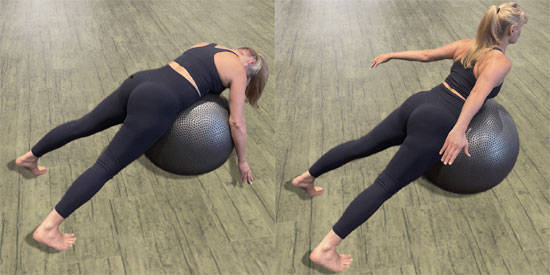
One way to improve this is to use a Swiss Ball.
M Extension on Swiss Ball
1. Lay your stomach on the ball and go completely limp over it.
2. Push your hips INTO the ball, which forces your core to activate and neutralize that extension in your lower back.
3. Slowly pull your chest away from the ball, extending your upper back.
4.
Twist your elbows into your body and put your palms down and away. It will look like the letter M.
5. Try and do this without bending your knees.
6. Relax and repeat 5-10 times, twice a day.
The chin tuck is another exercise to improve posture.
1. Sit or stand up straight with your shoulders relaxed and your arms at your sides.
2. Look straight ahead and keep your chin level.
3. Slowly and gently draw your chin backward and downward toward your neck, as if making a double chin.
4. Keep your gaze straight ahead and avoid tilting your head up or down.
5. Hold the position for 3-5 seconds, feeling a stretch in the back of your neck.
6. Release the position slowly and repeat the exercise for 10-15 repetitions.
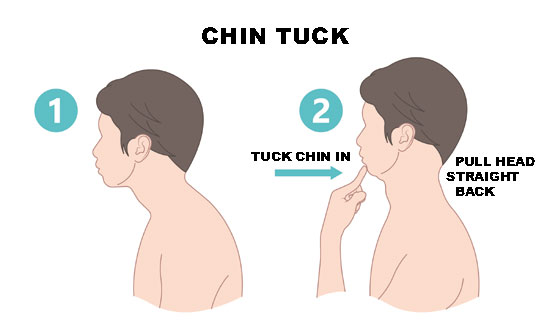
It's important to remember that the chin tuck is a subtle movement, so don't force it or strain your neck muscles. You can do this exercise several times a day to help improve your posture and reduce neck pain.
Understanding this connection between mood and posture can help us take proactive steps toward improving our physical and mental well-being. Next time you catch yourself slouching, remember to straighten up and let the positive effects on your mood unfold.
Reference Links:
Physical posture: Could it have regulatory or feedback effects on motivation and emotion?
John H. Riskind & Carolyn C. Gotay
Motivation and Emotion, Published September 1982 doi.org/10.1007/BF00992249
Do slumped and upright postures affect stress responses? A randomized trial.
Nair, S., Sagar, M., Sollers, J. III, Consedine, N., & Broadbent, E.
Health Psychology by the American Psychological Association, Published 2015 34(6), 632–641. https://doi.org/10.1037/hea0000146
How Posture Affects Memory Recall and Mood
Erik Peper, I-Mei Lin, Richard Harvey, Jacob Perez
Biofeedback, Published April 2017, Volume 45, Issue 2, pp. 36–41 DOI: 10.5298/1081-5937-45.2.01
Research Paper: Effects of 4 Week Postural Corrective Exercise on Correcting Forward Head Posture
Zahra Abdollahzade, Azade Shadmehr, Kazem Malmir, Nastaran Ghotbi
Journal of Modern Rehabilitation, Received: 16 Nov. 2016 Accepted: 23 Feb. 2017
Increase or Decrease Depression: How Body Postures Influence Your Energy Level
Erik Peper, PhD; I-Mei Lin, PhD
Biofeedback, Published 2012 40 (3): 125–130. https://doi.org/10.5298/1081-5937-40.3.01
The efficiency of corrective exercise interventions on thoracic hyper-kyphosis angle
Foad Seidi, Reza Rajabi, Ismail Ebrahimi, Mohamad Hossein Alizadeh, Hooman Minoonejad
Journal of Back and Musculoskeletal Rehabilitation, Published 2014;27(1):7-16. doi: 10.3233/BMR-130411.
The effect of a corrective functional exercise program on postural thoracic kyphosis in teenagers: a randomized controlled trial
Qiang Feng, Mei Wang, Yanfeng Zhang, Yu Zhou
Clinical Rehabilitation, Published 2018 Jan;32(1):48-56. doi: 10.1177/0269215517714591. Epub 2017 Jun 14.
Call for a FREE Consultation (305) 296-3434
CAUTION: Check with your doctor before
beginning any diet or exercise program.
4/22/2023


