


Two Common Habits Linked to Stroke
A Neurologist's Two Rules for Protecting Your Brain
A neurologist told me there are two things he refuses to do. He avoids them because he's seen them linked to stroke in real patients. Not in theory, in patients sitting across from him.
The first is using a massage gun on his neck.
Massage guns are useful tools for sore muscles in the thighs, hips, glutes, upper back, and shoulders. The problem is not the device. It's where people sometimes use it.
Four major arteries carry blood to the brain through the neck. The carotid arteries run up the front and sides. The vertebral arteries travel along the back of the neck through small openings in the bones before joining at the base of the brain.
In rare cases, strong percussion near these vessels can cause arterial dissection, a small tear in the lining of the artery. A clot forms at the tear and travels to the brain, blocking blood flow. In people with significant vascular disease, there is also evidence that strong percussion near the carotid artery may disrupt unstable plaque.
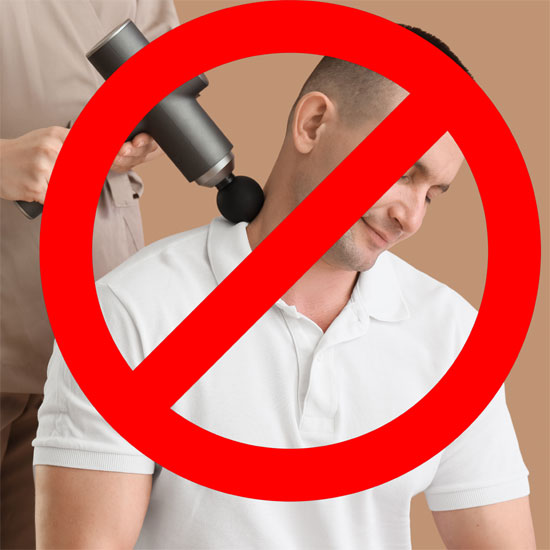
Avoid using a massage gun on your neck.
The medical literature contains several documented cases. One report described a woman in her twenties who developed vertebral artery dissection after using a massage gun on her neck. Another involved a 79-year-old man who suffered a stroke after a single session with a handheld neck massager, with imaging showing disrupted carotid plaque.
Most patients had underlying risk factors such as connective tissue disorders, uncontrolled hypertension, or pre-existing arterial disease. But some appeared otherwise healthy.
Millions of massage guns are used safely every day. Smoking, uncontrolled blood pressure, and atrial fibrillation carry far greater stroke risk. Still, this is an easy risk to avoid.
Use massage guns only on large muscle groups. Stay away from the front and sides of the neck and the base of the skull. Use moderate intensity and keep the device moving rather than holding it in one spot. If you have vascular disease, connective tissue disorders, or uncontrolled hypertension, skip the neck entirely.
The second thing the neurologist avoids is something most people have never thought twice about. It even has a name: Beauty Parlor Stroke Syndrome.
You've probably been in this position. You lean back in a salon chair while your hair is washed over a basin. Your neck rests on the edge, your head tilts far back, and you stay there for several minutes.
When the neck tilts that far back and stays there, it can compress or kink the vertebral arteries, reducing blood flow to the back of the brain. In people with pre-existing arterial disease or structural abnormalities in the cervical spine, that reduced flow can trigger a stroke.

Ask for a towel or cushion under your neck so your head stays closer to neutral.
A 2025 scoping review in the American Journal of Emergency Medicine identified 54 reported cases. Most occurred during salon visits, though similar events have been reported in dental chairs and other situations involving prolonged neck hyperextension. The patients tended to be older and more often female. Many had underlying arterial disease or structural problems in the cervical spine.
The fix is simple.
Ask for a towel or cushion under your neck. Request an adjustment that keeps your head closer to neutral. If you feel dizziness, nausea, or vision changes while your head is tilted back, sit up immediately and say something. The same applies in dental chairs or anywhere your neck is forced far back for an extended period.
Finally, know the warning signs of stroke. Use the FAST acronym: Face drooping, Arm weakness, Speech difficulty, Time to call 911.

Also pay attention to a sudden severe headache that feels different from anything you have experienced before, or any new dizziness and vision changes that follow neck pressure or an awkward position.
The neurologist who told me all this made it sound easy, because it is. Keep the massage gun off your neck. Speak up when your head is forced back. Two small habits. And if something feels wrong, do not wait to see if it passes. With stroke, time is brain tissue.
Reference Links:
Case Report: Vertebral Artery Dissection After Use of Handheld Massage Gun
Kathryn Sulkowski, Georgina Grant, Thomas Brodie
Clinical Practices and Cases in Emergency Medicine, Published 2022 May 6
Click Here for the Study: https://doi.org/10.5811/cpcem.2022.2.56046
Home Self-Massage Device Necessitates Public Awareness: Vertebral Artery Dissection Associated With a Home Massage Device
Erum Shariff, Ziyad T. Al Ghannam, Fahad A. AlDamigh, Abdulhadi G. AlGhamdi, Yazan M. AlEisawi, Khalid F. Aloqalaa, Basil Z. Sallout
CUREUS, Published January 05, 2023
Click Here for the Study: https://doi.org/10.7759/cureus.33394
Embolic stroke associated with handheld electric neck massager: A case report and literature review
Anika Pruthi, Joshua Santucci, Swarna Rajagopalan, Hermann C. Schumacher, Daniel A. Tonetti
Journal of Stroke & Cerebrovascular Diseases, Published Volume 34, Issue 1108086 January 2025
Click Here for the Study: https://doi.org/10.1016/j.jstrokecerebrovasdis.2024.108086
Vertigo and Ischemic Stroke after Hyperextension (Beauty Parlour Stroke syndrome)
Bünyamin Tosunoğlu, Sultan Merve Ünal, Seyfi Emre Aksoy, Tahir Kurtuluş Yoldaş
Vilnius University Press, Published 2022. Vol. 29. No 2, pp. 302–305
Click Here for the Study: https://doi.org/10.15388/amed.2022.29.2.2
Stroke at the Hairdresser's chair: A scoping review of the beauty parlor stroke syndrome
Georgios Mavrovounis, Konstantinos Drivas, Argyro Syrakouli, Evangelia Syrakouli, Maria Mermiri, Panagiotis Papanagiotou, Ioannis Pantazopoulos
The American Journal of Emergency Medicine, Published May 2025, Pages 29-36
Click Here for the Study: https://doi.org/10.1016/j.ajem.2025.02.016
The potential dangers of neck manipulation & risk for dissection and devastating stroke: An illustrative case & review of the literature
Ryan C. Turner, Brandon P. Lucke-Wold, Sohyun Boo, Charles L. Rosen, Cara L. Sedney
Biomedical Research and Reviews, Published March 25, 2018
Click Here for the Study: https://doi.org/10.15761/BRR.1000110
Call for a FREE Consultation (305) 296-3434
CAUTION: Check with your doctor before
beginning any diet or exercise program.
3/16/2026


