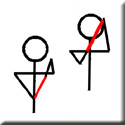
Back Scratch Test:
A Simple Measure of How You’re Aging
Try this right now. Reach one arm over your shoulder and slide your hand down your back, palm facing in. At the same time, bring your other arm up from behind your waist, palm facing out. Try to touch your middle fingers together.
How did that go?
If you winced, strained, or gave up halfway, you're not alone. And according to decades of fitness research on older adults, your result is worth paying attention to. Here's what that test is measuring.
This is called the Back Scratch Test. It was developed by researchers Roberta Rikli and Jessie Jones at California State University, Fullerton. Today, it's used by fitness professionals and physical therapists worldwide to track how well older adults are aging physically. The norms are based on testing thousands of adults between the ages of 60 and 94 across multiple US states.
What it measures is shoulder flexibility, which sounds boring until you think about what shoulder flexibility is actually for. Fastening a seatbelt. Putting on a jacket. Reaching a high shelf. Washing your own back. These are not athletic feats. They're a typical Tuesday, and the ability to do them without help is exactly what the research is tracking.
How to score yourself. Have someone measure the distance between your middle fingertips after you do the test. If your fingers overlap, that is a positive number. If there's a gap, that's a negative number. Do both sides and use the better result. Then compare your score to the reference table to see where you land for your age and sex.
Measure distance between middle fingers (inches).
Negative = gap | Positive = overlap
Men
| Age (years) |
Lower range |
Typical range |
Higher range |
|---|---|---|---|
60–64 |
less than −6.5 |
−6.5 to 0 |
greater than 0 |
65–69 |
less than −7.5 |
−7.5 to −1.0 |
greater than −1.0 |
70–74 |
less than −8.0 |
−8.0 to −1.0 |
greater than −1.0 |
75–79 |
less than −9.0 |
−9.0 to −2.0 |
greater than −2.0 |
80–84 |
less than −9.5 |
−9.5 to −2.0 |
greater than −2.0 |
85–89 |
less than −9.5 |
−9.5 to −3.0 |
greater than −3.0 |
90–94 |
less than −10.5 |
−10.5 to −4.0 |
greater than −4.0 |
Women
| Age (years) |
Lower range |
Typical range |
Higher range |
|---|---|---|---|
60–64 |
less than −3.0 |
−3.0 to 1.6 |
greater than 1.6 |
65–69 |
less than −3.7 |
−3.7 to 1.3 |
greater than 1.3 |
70–74 |
less than −4.2 |
−4.2 to 0.8 |
greater than 0.8 |
75–79 |
less than −4.8 |
−4.8 to 0.6 |
greater than 0.6 |
80–84 |
less than −5.4 |
−5.4 to 0.2 |
greater than 0.2 |
85–89 |
less than −6.9 |
−6.9 to −0.9 |
greater than −0.9 |
90–94 |
less than −8.0 |
−8.0 to −1.0 |
greater than −1.0 |
This table is adapted from population percentiles reported in the Senior Fitness Test (Rikli & Jones). The ranges reflect typical values for each age group and are intended for general reference, not diagnosis.
Here's where most people are surprised. A gap is not automatically bad. Men in their 60s can have a gap of several inches and still fall in the normal range. Women tend to score better on flexibility tests across the board, which is consistent throughout the research.
Shoulder flexibility on its own matters for daily life. But research points to something broader. A related test, the Sitting-Rising Test, measures whether you can get down to the floor and back up without help. Studies found that people who struggled with it had significantly higher mortality risk over time, even after accounting for age and other health factors.
The back scratch test doesn't predict how long you'll live. What the research suggests is that keeping your body moving well through its full range of motion is part of staying independent and functional as you age. A poor score is not a verdict; it's a starting point.
Fortunately, the fix may be simpler than you think. Shoulder flexibility responds to training at any age. A cross-body arm stretch, a doorway pec stretch, and an overhead triceps stretch done consistently two to three times a week will move the needle for most people. Hold each stretch for 20 to 30 seconds per side. Retest yourself every four to eight weeks.
If you have shoulder pain, a history of dislocation, or recent surgery, check with a physical therapist before pushing into end-range stretches.
Most people track their blood pressure and cholesterol. Almost nobody tracks shoulder flexibility. The back scratch test takes 90 seconds, costs nothing, and gives you a real number you can improve.
Take the test. Write down the number. See what it looks like in two months.
Reference Links:
Development and Validation of Criterion-Referenced Clinically Relevant Fitness Standards for Maintaining Physical Independence in Later Years
Roberta E. Rikli, C. Jessie Jones
The Gerontologist, Published 20 May 2012
Click Here for the Study: https://doi.org/10.1093/geront/gns071
Functional Fitness Normative Scores for Community-Residing Older Adults, Ages 60-94
Roberta E. Rikli, C. Jessie Jones
Journal of Aging and Physical Activity, Published Volume 7 (1999): Issue 2 (Apr 1999)
Click Here for the Study: https://doi.org/10.1123/japa.7.2.162
Development and Validation of a Functional Fitness Test for Community-Residing Older Adults
Roberta E. Rikli and C. Jessie Jones
Journal of Aging and Physical Activity, Published Volume 7 (1999): Issue 2 (Apr 1999)
Click Here for the Study: https://doi.org/10.1123/japa.7.2.129
Sitting–rising test scores predict natural and cardiovascular causes of deaths in middle-aged and older men and women
Claudio Gil S Araújo, Christina G de Souza e Silva, Jonathan Myers, Jari A Laukkanen, Plínio Santos Ramos, Djalma Rabelo Ricardo
European Journal of Preventive Cardiology, Published 18 June 2025
Click Here for the Study: https://doi.org/10.1093/eurjpc/zwaf325
Call for a FREE Consultation (305) 296-3434
CAUTION: Check with your doctor before
beginning any diet or exercise program.
4/27/2026