


Normal Isn't Good Enough Anymore
The Cholesterol Mystery That Changed Cardiology
About 15 years ago, something troubling was happening in cardiology. Doctors were prescribing statins, patients were taking them, and cholesterol numbers were dropping. The heart attacks and strokes kept coming anyway.
It raised an uncomfortable question. If you get someone's cholesterol into a normal range and they still have a cardiac event, what did you actually accomplish?
That question forced researchers to look at cholesterol differently. For years, the goal was to get LDL, the "bad" cholesterol, back into a normal range. If your lab report said "optimal," everyone relaxed. But as more data accumulated, a different pattern emerged. People who had naturally low LDL from early in life were far less likely to have heart attacks. People who started out high and were brought down to "normal" later still had a lot of cardiovascular events.
It began to look as though cardiovascular risk has a memory. The longer LDL stays elevated, the more plaque builds up in artery walls. Lowering LDL later in life is still helpful, just not as powerful as keeping it low all along. To make a meaningful dent in risk, you often have to push LDL lower than what used to be called normal, especially if it's been high for many years.
That's why many current guidelines no longer talk about a single good number for everyone. They match the target to the person's overall risk and history.
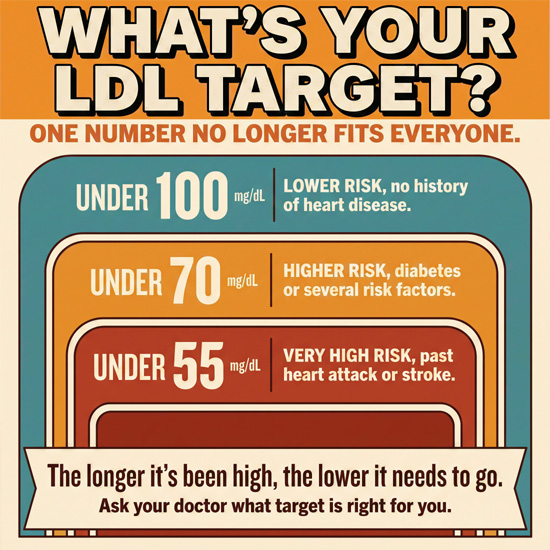
- For someone at relatively low risk with no history of heart disease, an LDL under 100 mg/dL is generally acceptable.
- For someone with diabetes or several other risk factors, the target often drops below 70 mg/dL.
- For people at very high risk who have already had a heart attack or stroke, many experts now aim for below 55 mg/dL, and in certain situations, even lower.
The higher your LDL has been, and the longer it has stayed that way, the more aggressively you need to lower it now. Statins remain the main tool doctors use to reach those levels. In people at high cardiovascular risk, they genuinely reduce heart attacks, strokes and death.
But like any powerful medication, they come with trade-offs. One of the most important, and least discussed, is their effect on blood sugar.
Statins can nudge blood sugar and A1c upward. For many people the change is small. For others who are already close to the edge, that nudge is enough to cross the line into type 2 diabetes. One large Finnish observational study found roughly a 46% higher relative risk of developing diabetes among statin users.
In real terms, if 10 out of 100 people would have developed diabetes anyway, statin use might push that to around 14 or 15. When you look across many randomized trials, the absolute impact works out to closer to one or two extra cases per 100 people treated over several years, with most of that risk concentrated in people already predisposed through prediabetes, obesity, or metabolic syndrome. The FDA added a diabetes warning to all statin labels in 2012.
Why does a cholesterol drug affect blood sugar? One leading explanation involves how statins work at the cellular level. They block HMG-CoA reductase, the enzyme that controls the rate of cholesterol production in the liver. That enzyme sits in the middle of a longer assembly line that produces several important compounds beyond cholesterol. Slow it down and you reduce the levels of certain intermediates that cells depend on for other jobs.
Experimental studies suggest these compounds help muscle cells respond to insulin and may influence how much insulin the pancreas releases, especially in that early burst right after a meal. In susceptible people, modest changes across several of these pathways seem to add up, and researchers are still working to confirm exactly how much each mechanism contributes.
If you are on a statin and your blood sugar starts creeping up, don't stop the medication. Treat rising blood sugar as a signal. Talk to your doctor about your dose, your overall risk, and the parts of your life that influence both cholesterol and glucose. For some people, adjusting the dose or switching to a different statin is the right move. For others, tightening lifestyle habits makes the bigger difference.
The old story about cholesterol was simple: your number is high, here's a pill to bring it down. The newer story is more demanding and more honest. How long has your LDL been elevated? How low does it actually need to go for you? And what else can you do, alongside any prescription, to stack the odds in your favor? Those are questions worth asking your doctor.
Reference Links:
Low-density lipoproteins cause atherosclerotic cardiovascular disease. 1. Evidence from genetic, epidemiologic, and clinical studies. A consensus statement from the European Atherosclerosis Society Consensus Panel
Brian A. Ference , Henry N. Ginsberg , Ian Graham , Kausik K. Ray , Chris J. Packard , Eric Bruckert , Robert A. Hegele , Ronald M. Krauss , Frederick J. Raal , Heribert Schunkert , Gerald F. Watts , Jan Borén , Sergio Fazio , Jay D. Horton , Luis Masana , Stephen J. Nicholls , Børge G. Nordestgaard , Bart van de Sluis , Marja-Riitta Taskinen , Lale Tokgözoğlu , Ulf Landmesser , Ulrich Laufs , Olov Wiklund , Jane K. Stock , M. John Chapman , Alberico L. Catapano
European Heart Journal, Published Volume 38, Issue 32, 21 August 2017, Pages 2459–2472
Click Here for the Study: https://doi.org/10.1093/eurheartj/ehx144
Association of Genetic Variants Related to CETP Inhibitors and Statins With Lipoprotein Levels and Cardiovascular Risk
Brian A. Ference, MD, MPhil, MSc; John J. P. Kastelein, MD, PhD; Henry N. Ginsberg, MD M. John Chapman, PhD, DSc; Stephen J. Nicholls, MBBS, PhD; Kausik K. Ray, MD, MPhil; Chris J. Packard, DSc; Ulrich Laufs, MD, PhD; Robert D. Brook, MD; Clare Oliver-Williams, PhD; Adam S. Butterworth, PhD; John Danesh, FRCP, DPhi; George Davey Smith, MD, DSc; Alberico L. Catapano, PhD; Marc S. Sabatine, MD, MPH
JAMA Network, Published Online: September 12, 2017
Click Here for the Study: https://jamanetwork.com/journals/jama/fullarticle/2650886
2019 ESC/EAS Guidelines for the management of dyslipidaemias: lipid modification to reduce cardiovascular risk
François Mach (ESC Chairperson) (Switzerland), Colin Baigent (ESC Chaiperson) (United Kingdom), Alberico L. Catapano( EAS Chairperson) (Italy), Konstantinos C. Koskinas (Switzerland), Manuela Casula1 (Italy), Lina Badimon (Spain), M. John Chapman1 (France), Guy G. De Backer (Belgium), Victoria Delgado (Netherlands), Brian A. Ference (United Kingdom), Ian M. Graham (Ireland), Alison Halliday (United Kingdom), Ulf Landmesser (Germany), Borislava Mihaylova (United Kingdom), Terje R. Pedersen (Norway), Gabriele Riccardi1 (Italy), Dimitrios J. Richter (Greece), Marc S. Sabatine (United States of America), Marja-Riitta Taskinen1 (Finland), Lale Tokgozoglu1 (Turkey), Olov Wiklund1 (Sweden).
ESC European Society of Cardiology, Published 2019
Click Here for the Study: https://eas-society.org/wp-content/uploads/2022/11/2019_dyslipidaemias_guidelin.pdf
Statin Treatment-Induced Development of Type 2 Diabetes: From Clinical Evidence to Mechanistic Insights
Unai Galicia-Garcia, Shifa Jebari, Asier Larrea-Sebal, Kepa B. Uribe, Haziq Siddiqi, Helena Ostolaza, Asier Benito-Vicente and César Martín
International Journal of Molecular Sciences, Published 2 July 2020
Click Here for the Study: https://doi.org/10.3390/ijms21134725
Risk of Incident Diabetes With Intensive-Dose Compared With Moderate-Dose Statin Therapy
A Meta-analysis
David Preiss, MRCP; Sreenivasa Rao Kondapally Seshasai, MD; Paul Welsh, PhD Sabina A. Murphy, MPH; Jennifer E. Ho, MD; David D. Waters, MD; David A. DeMicco, DPharm; Philip Barter, MD, PhD; Christopher P. Cannon, MD; Marc S. Sabatine, MD, MPH; Eugene Braunwald, MD; John J. P. Kastelein, MD, PhD; James A. de Lemos, MD; Michael A. Blazing, MD; Terje R. Pedersen, MD, PhD; Matti J. Tikkanen, MD, PhD; Naveed Sattar, MD, PhD; Kausik K. Ray, MD
JAMA Network, Published Online: June 22 2011
Click Here for the Study: https://doi.org/10.1001/jama.2011.860
Statins and risk of incident diabetes: a collaborative meta-analysis of randomised statin trials
Prof Naveed Sattar, PhDa Send email to nsattar@clinmed.gla.ac.uk ∙ Dr David Preiss, MRCPa Send email to d.preiss@clinmed.gla.ac.uk ∙ Heather M Murray, MScb ∙ Paul Welsh, PhDa ∙ Prof Brendan M Buckley, FRCPIc ∙ Anton JM de Craen, PhDd ∙ Sreenivasa Rao Kondapally Seshasai, MDe ∙ Prof John J McMurray, MDa ∙ Dilys J Freeman, PhDf ∙ Prof J Wouter Jukema, MDg ∙ Prof Peter W Macfarlane, DSch ∙ Prof Chris J Packard, DSch ∙ Prof David J Stott, MDh ∙ Prof Rudi G Westendorp, MDi ∙ Prof James Shepherd, MDh ∙ Prof Barry R Davis, PhDj ∙ Sara L Pressel, MSj ∙ Prof Roberto Marchioli, MDk ∙ Prof Rosa Maria Marfisi, MSk ∙ Prof Aldo P Maggioni, MDl ∙ Prof Luigi Tavazzi, MDm ∙ Prof Gianni Tognoni, MDk ∙ Prof John Kjekshus, MDn ∙ Prof Terje R Pedersen, MDo ∙ Thomas J Cook, MSp ∙ Prof Antonio M Gotto, MDq ∙ Prof Michael B Clearfield, DOr ∙ John R Downs, MDs ∙ Prof Haruo Nakamura, MDt ∙ Prof Yasuo Ohashi, MDu ∙ Prof Kyoichi Mizuno, MDv ∙ Kausik K Ray, MDe ∙ Prof Ian Ford, PhD
THE LANCET, Published February 27, 2010
Click Here for the Study: https://doi.org/10.1016/s0140-6736(09)61965-6
Increased risk of diabetes with statin treatment is associated with impaired insulin sensitivity and insulin secretion: a 6 year follow-up study of the METSIM cohort
Henna Cederberg, Alena Stančáková, Nagendra Yaluri, Shalem Modi, Johanna Kuusisto & Markku Laakso
Springer Nature Link, Published 10 March 2015
Click Here for the Study: https://doi.org/10.1007/s00125-015-3528-5
The effects of lowering LDL cholesterol with statin therapy in people at low risk of vascular disease: meta-analysis of individual data from 27 randomised trials
Cholesterol Treatment Trialists' (CTT) Collaborators: J de Lemos, E Braunwald, M Blazing, S Murphy, J R Downs, A Gotto, M Clearfield, H Holdaas, D Gordon, B Davis, M Koren, B Dahlof, N Poulter, P Sever, R H Knopp, B Fellström, H Holdaas, A Jardine, R Schmieder, F Zannad, U Goldbourt, E Kaplinsky, H M Colhoun, D J Betteridge, P N Durrington, G A Hitman, J Fuller, A Neil, C Wanner, V Krane, F Sacks, L Moyé, M Pfeffer, C M Hawkins, E Braunwald, J Kjekshus, H Wedel, J Wikstrand, P Barter, A Keech, L Tavazzi, A Maggioni, R Marchioli, G Tognoni, M G Franzosi, A Maggioni, H Bloomfield, S Robins, R Collins, J Armitage, A Keech, S Parish, R Peto, P Sleight, T R Pedersen, P M Ridker, R Holman, T Meade, J Simes, A Keech, S MacMahon, I Marschner, A Tonkin, J Shaw, P W Serruys, H Nakamura, G Knatterud, C Furberg, R Byington, P Macfarlane, S Cobbe, I Ford, M Murphy, G J Blauw, C Packard, J Shepherd, J Kjekshus, T Pedersen, L Wilhelmsen, E Braunwald, C Cannon, S Murphy, R Collins, J Armitage, L Bowman, S Parish, R Peto, P Sleight, C Baigent, M Landray, R Collins, J La Rosa, J Rossouw, J Probstfield, J Shepherd, S Cobbe, P Macfarlane, I Ford, M Flather, J Kastelein, C Newman, C Shear, J Tobert, J Varigos, H White, S Yusuf, M Mellies, M McGovern, J Barclay, R Belder, Y Mitchel, T Musliner, J-C Ansquer, M Llewellyn, M Bortolini, G Brandrup-Wognsen, B Bryzinski, G Olsson, J Pears, D DeMicco, C Baigent, E H Barnes, A Baxter, N Bhala, L Blackwell, G Buck, R Collins, J Emberson, W G Herrington, L E Holland, P M Kearney, A Keech, A Kirby, D A Lewis, I Marschner, C Pollicino, C Reith, J Simes, T Sourjina
THE LANCET, Published August 11, 2012
Click Here for the Study: https://doi.org/10.1016/s0140-6736(12)60367-5
Efficacy and safety of more intensive lowering of LDL cholesterol: a meta-analysis of data from 170 000 participants in 26 randomised trials
THE LANCET, Published November 13, 2010
Click Here for the Study: https://doi.org/10.1016/s0140-6736(10)61350-5
Call for a FREE Consultation (305) 296-3434
CAUTION: Check with your doctor before
beginning any diet or exercise program.
6/23/2026


