


The Boring Truth About Building Muscle
Easy Sets Don't Count
Walk into any gym and you'll hear people arguing about the best exercise, the perfect number of reps, or the one trick that finally makes muscles grow. Those things matter. But once you've picked good exercises and you're working hard, research points to something much simpler that makes a bigger difference.
It's how many hard sets each muscle gets every week.
Counting Your Sets
A rep, short for repetition, is doing a movement one time, like lowering into a squat and standing back up. A set is a group of reps done back to back before you rest. If you do 10 squats, rest, and then do 10 more, that's two sets of 10 reps. Scientists add up all the hard sets a muscle gets in a week and call that "volume."
What the Studies Found
In 2017, researcher Brad Schoenfeld and his team combined the results of many studies. Some people in those studies did fewer sets each week and some did more. The people who did more sets usually built more muscle.
In December 2025, researchers at Florida Atlantic University did a much bigger version of that project. They looked at 67 studies with more than 2,000 people. They found the same thing. More weekly sets usually meant more muscle and more strength.
Each extra set only helps a little, and results vary from person to person.
There's a catch. The sets have to be hard. A good goal is to stop when you could only do one to three more reps with good form. A 2024 study found that muscles tend to grow more when sets end closer to that point.
That doesn't mean you have to lift heavy. Lighter weights work too, as long as you do enough reps to make the set hard.
Most exercises work one main muscle, with other muscles helping out. A bench press mainly works your chest, but your triceps, on the back of your upper arms, help push the weight. To keep things simple, count each set toward the main muscle the exercise targets. Just remember the helpers get some work too. If your workouts already include lots of pushing and pulling, your arms may need fewer extra sets than you'd expect.
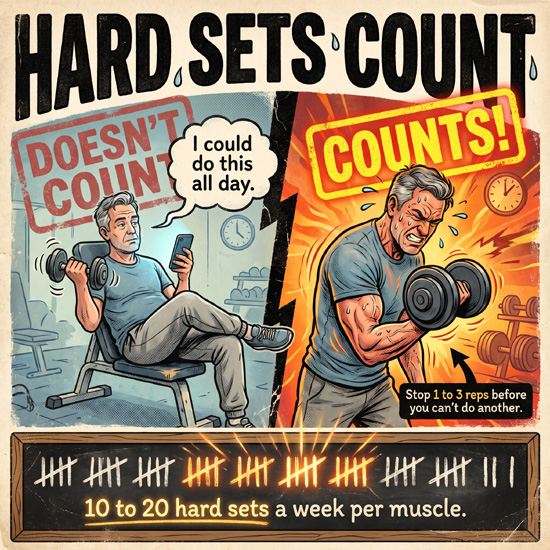
How many sets should you do?
Many trainers suggest 10 to 20 hard sets a week for each muscle you want to grow. That number comes from coaching experience, not from one study. If you're new to lifting, you'll probably grow just fine on less.
More helps, but only up to a point.
Think about eating pizza when you're hungry. The first slice is great. The second is good. By the sixth slice, each one does less for you, and you start feeling worse.
Sets work the same way. Each one helps a little less than the last, while you get more worn out. At some point, adding sets just makes you tired without making you bigger. Where that point is depends on the person.
Getting bigger and getting stronger aren't the same.
Adding sets helps most with muscle size.
For strength, more sets in one workout eventually stop adding much. But doing the lift more often during the week can still help. Strength is partly a skill, and practicing the movement more often helps you get better at it. The 2025 study found that more frequent training during a week helped strength more than it helped muscle size.
Most people in these studies were young men, around 25 years old, and most studies lasted only about ten weeks. Researchers believe these results probably apply to women and older adults too, but there's less proof.
Here's what you can do.
Pick a few good exercises for each muscle. Only count the sets that are truly hard. Start with a number of sets you can recover from and keep doing week after week.
Once a workout starts to feel easier, it's time to do a little more. Say you're doing three sets of 10 squats with 50 pounds. You could add a fourth set. You could do 12 reps instead of 10. Or you could move up to 55 pounds. Pick one change at a time and stick with it for a week or two before changing something else.
How do you know it's working? Don't go by soreness. Being sore just means your muscles did something new, not that they grew. Instead, check whether you're lifting more weight or doing more reps than you were a month ago. If your clothes fit a little tighter in the arms, shoulders, or thighs, that's a good sign too.
Your muscles don't care how clever your workout is. They care how much hard work they get.
Reference Links:
Strength and Hypertrophy Adaptations Between Low- vs. High-Load Resistance Training: A Systematic Review and Meta-analysis
Brad J. Schoenfeld, Jozo Grgic, Dan Ogborn, James W. Krieger
Journal of Strength and Conditioning Research, Published 31(12):p 3508-3523, December 2017
Click Here for the Study: https://doi.org/10.1519/JSC.0000000000002200
Exploring the Dose–Response Relationship Between Estimated Resistance Training Proximity to Failure, Strength Gain, and Muscle Hypertrophy: A Series of Meta-Regressions
Zac P. Robinson, Joshua C. Pelland, Jacob F. Remmert, Martin C. Refalo, Ivan Jukic, James Steele & Michael C. Zourdos
Sports Medicine, Published 06 July 2024
Click Here for the Study: https://doi.org/10.1007/s40279-024-02069-2
The Resistance Training Dose Response: Meta-Regressions Exploring the Effects of Weekly Volume and Frequency on Muscle Hypertrophy and Strength Gains
Joshua C. Pelland, Jacob F. Remmert, Zac P. Robinson, Seth R. Hinson & Michael C. Zourdos
Sports Medicine, Published 04 December 2025
Click Here for the Study: https://doi.org/10.1007/s40279-025-02344-w
Dose-response relationship between weekly resistance training volume and increases in muscle mass: A systematic review and meta-analysis
Brad J. Schoenfeld, Dan Ogborn & James W. Krieger
Journal of Sports Sciences, Published Online: 19 Jul 2016
Click Here for the Study: https://doi.org/10.1080/02640414.2016.1210197
Call for a FREE Consultation (305) 296-3434
CAUTION: Check with your doctor before
beginning any diet or exercise program.
9/16/2026


